NLIGHTD L3 MAO 18350-sized 15W LEP Torch Review
NLIGHTD L3 MAO LEP Torch#
- Specifications
- Introduction
- Torch in use
- Build quality
- LED, bezel, lens, reflector and beam
- Size and comparison
- User interface
- Batteries and charging
- Performance
- Beamshots
- Thermal Images
- Conclusion
- Price
- Product page
Specifications#
| Brand/model | NLIGHTD L3 MAO |
|---|---|
| LEP | 15W shine-through LEP module |
| Maximum lumens | 1,000 lm |
| Maximum beam intensity | 562,500 cd |
| Maximum throw | 1,500 m |
| Battery | 1*18350 |
| Onboard charging | No |
| Material | Aluminium |
| Modes | 2 |
| Blinkies | Strobe |
| Waterproof | IPX8 |
| Review date | May 2026 |
Introduction#
The NLIGHTD L3 MAO is an 18350-sized torch with a 15W shine-through LEP module. It comes with a spare 18650 tube to increase the capacity and runtime.
The MAO finish looks and feels gorgeous. But I ran into an issue while doing this review.
A dark spot appeared in the middle of the beam after using High for a few minutes with a high drain cell.
I bought a digital microscope to inspect the LEP module. More details and test results are below.
This review should have been completed last year. Apologies for the delay!
NLIGHTD is a brand by nealsgadgets.com.
Neal kindly provided this torch for review. I have not been paid for this review nor have I held back my opinions of this torch.
Packaging#
The NLIGHTD L3 MAO comes in a cardboard box with foam.
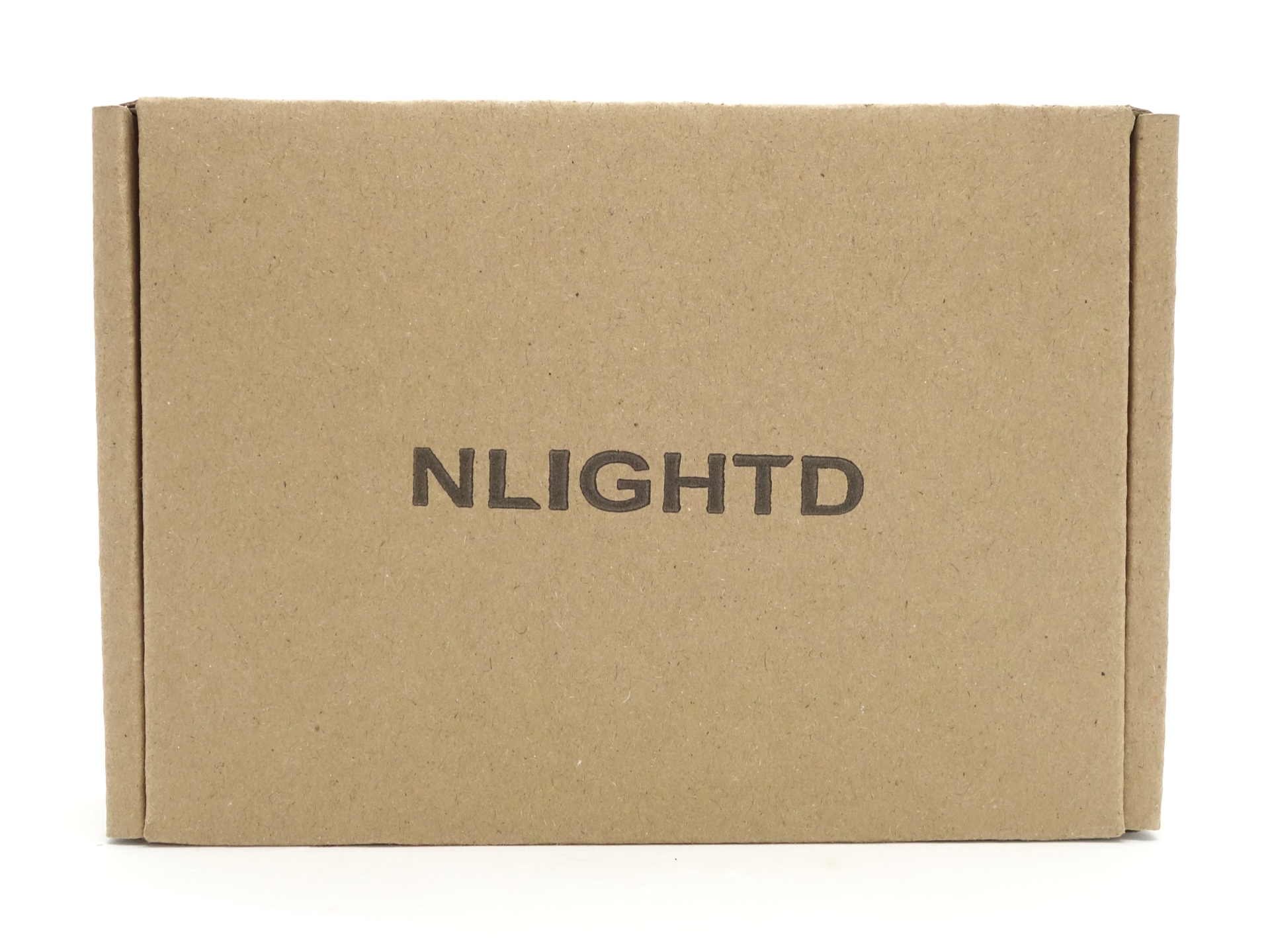
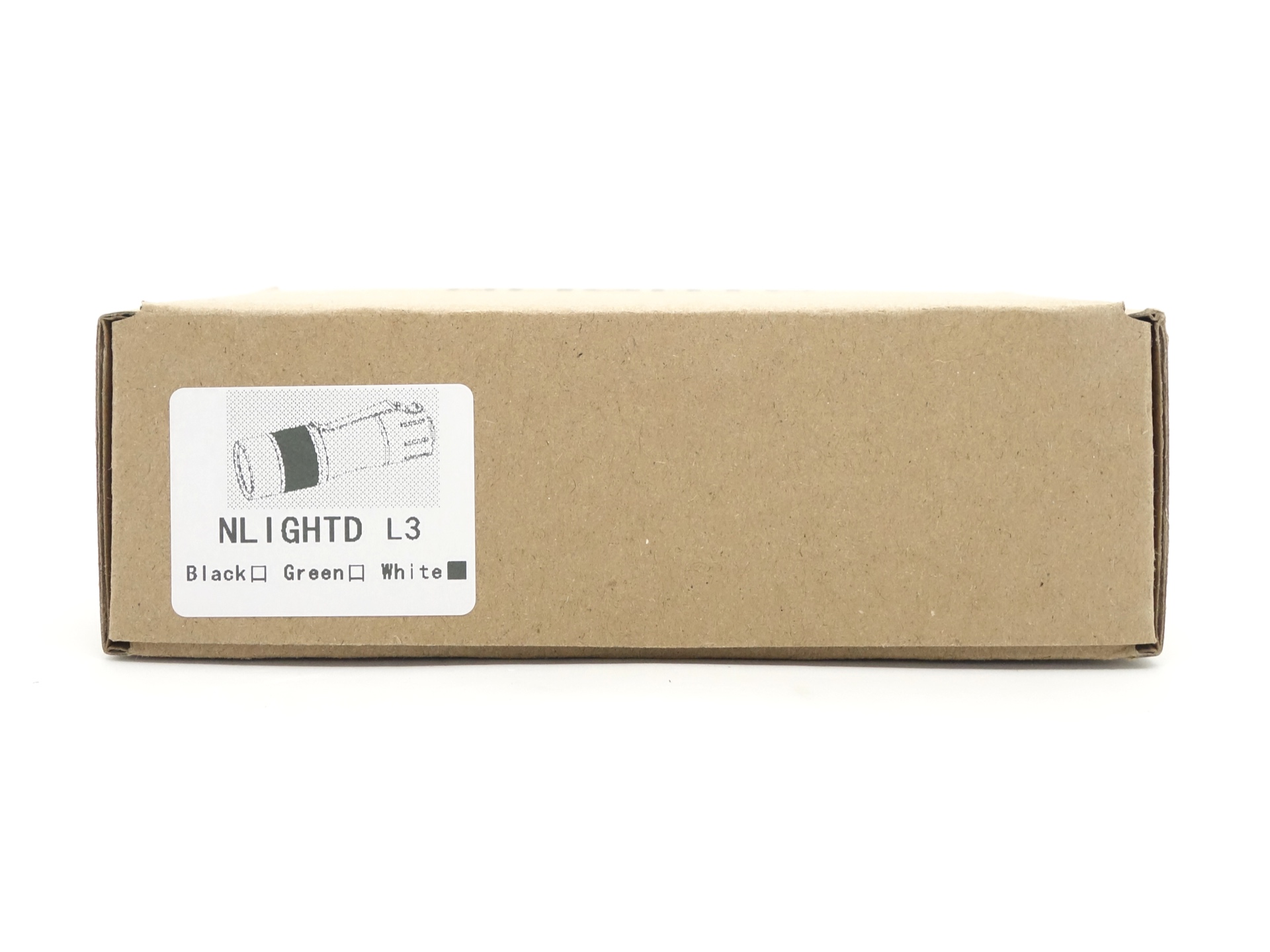
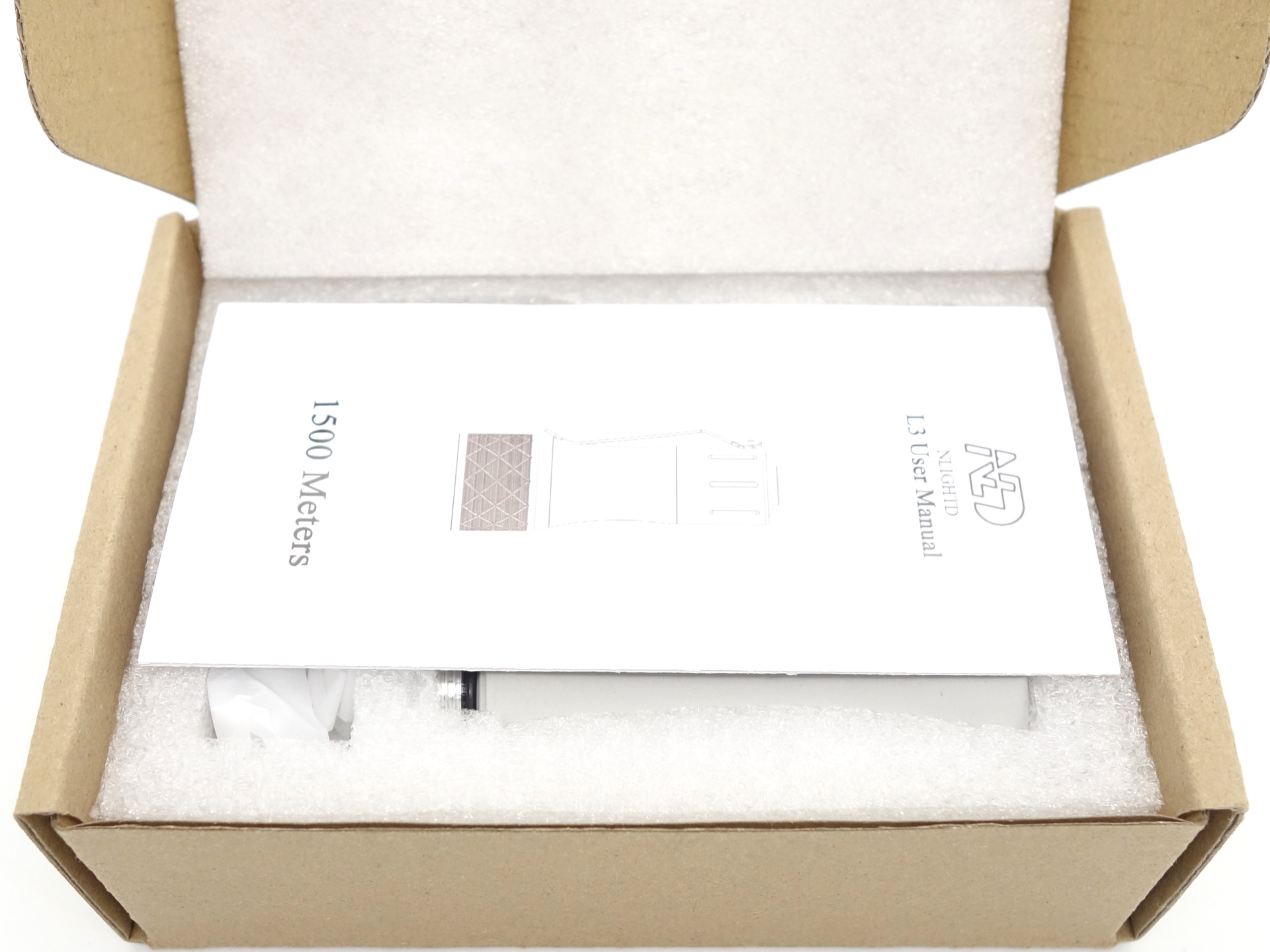
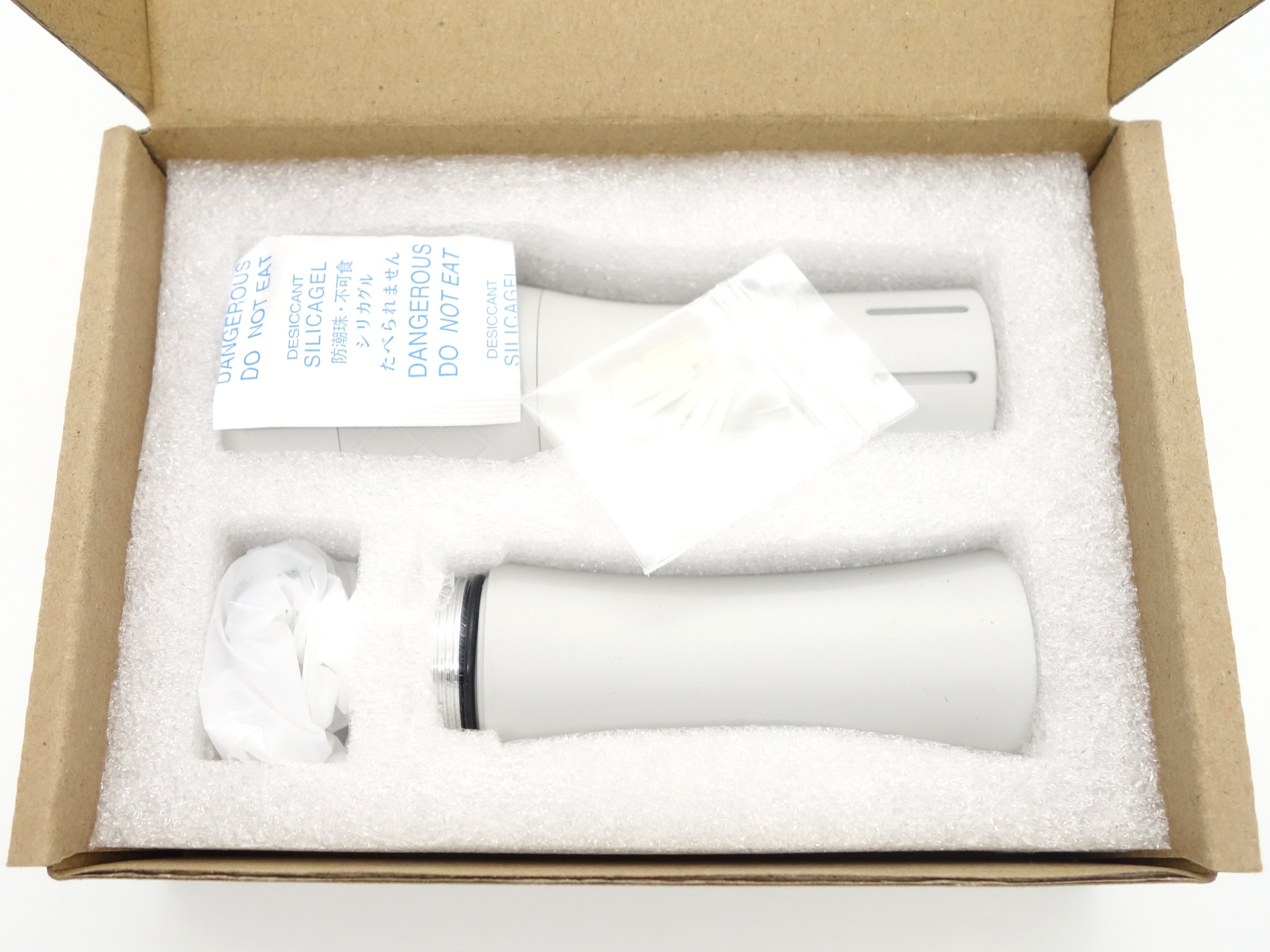
The following is included in the box:
- NLIGHTD L3 MAO with 18350 tube.
- NLIGHTD 18350 3.6V Li-ion 1600mAh 5A cell.
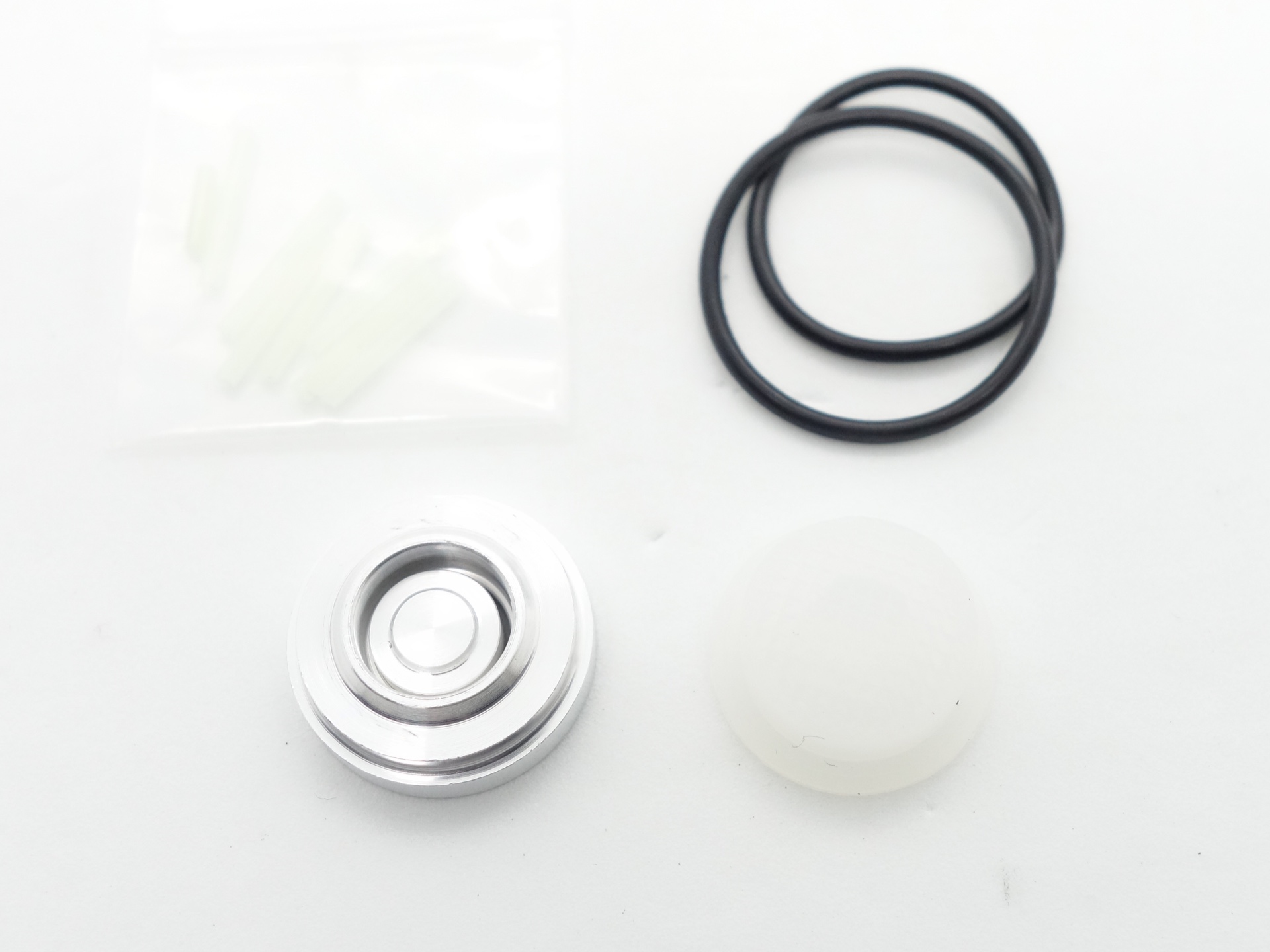
- Two spare o-rings.
- Spare silicone button cover (to swap with the metal button).
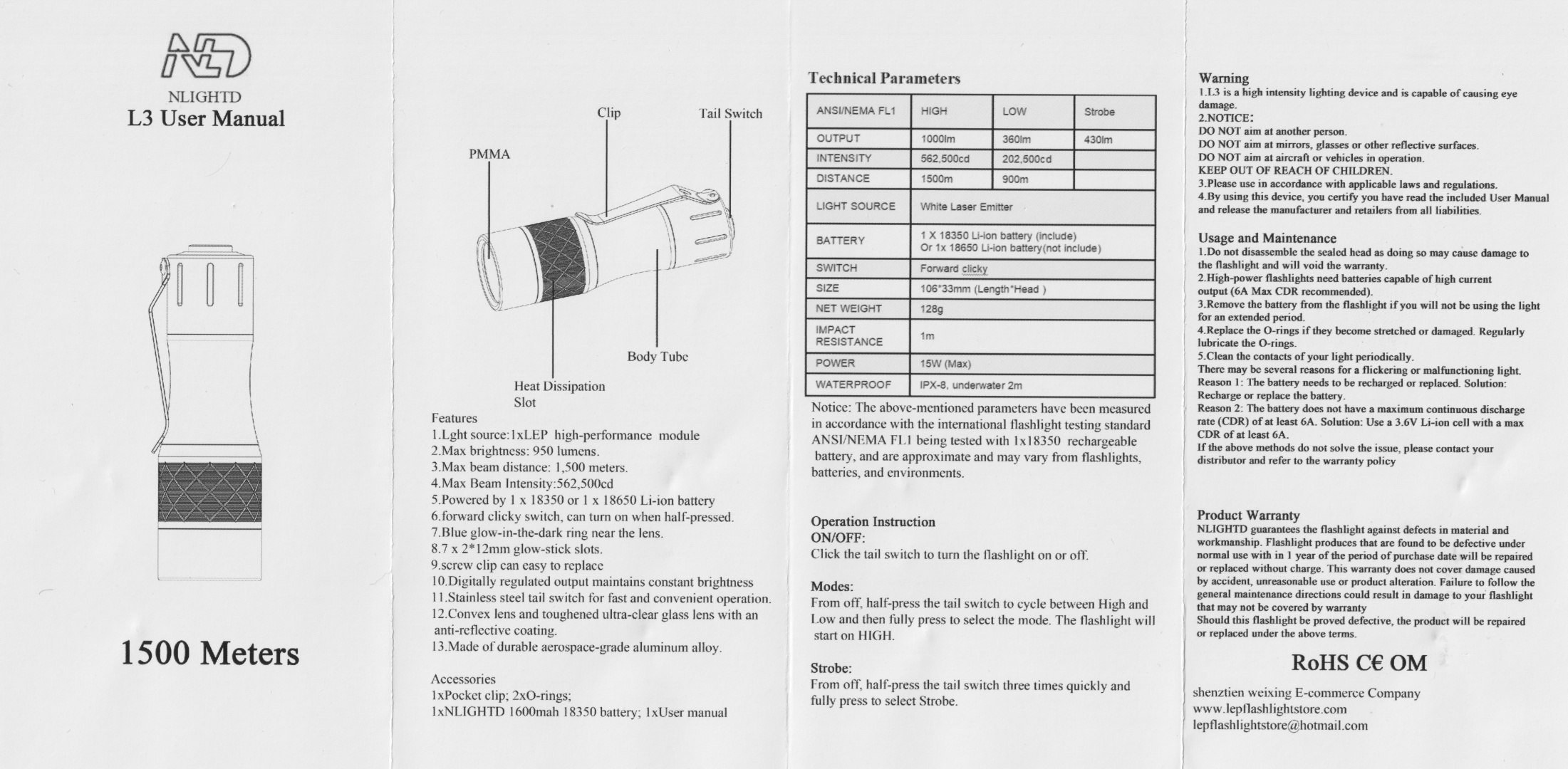
- User manual.
- Optional 18650 tube.
User manual#
Torch in use#
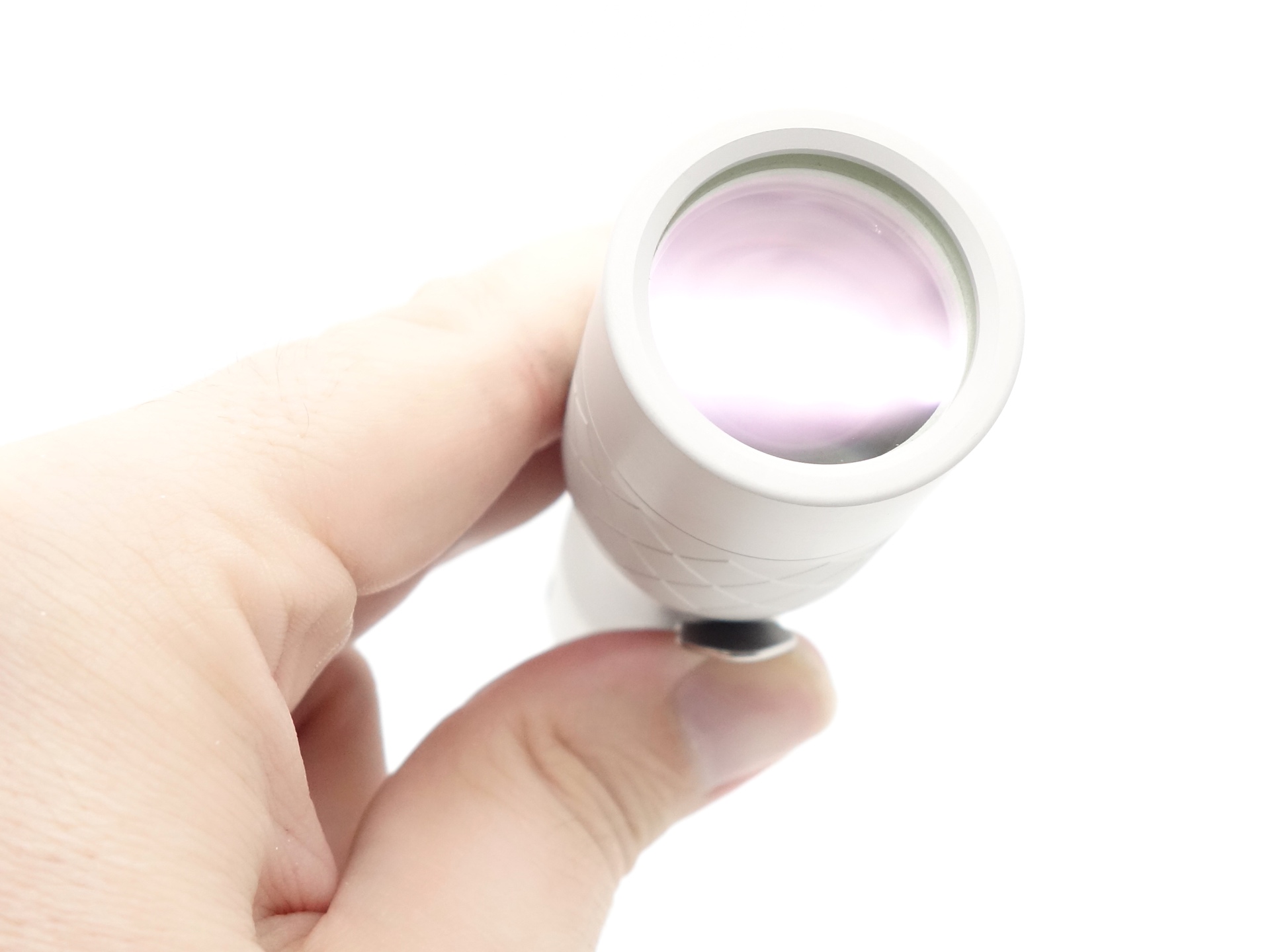
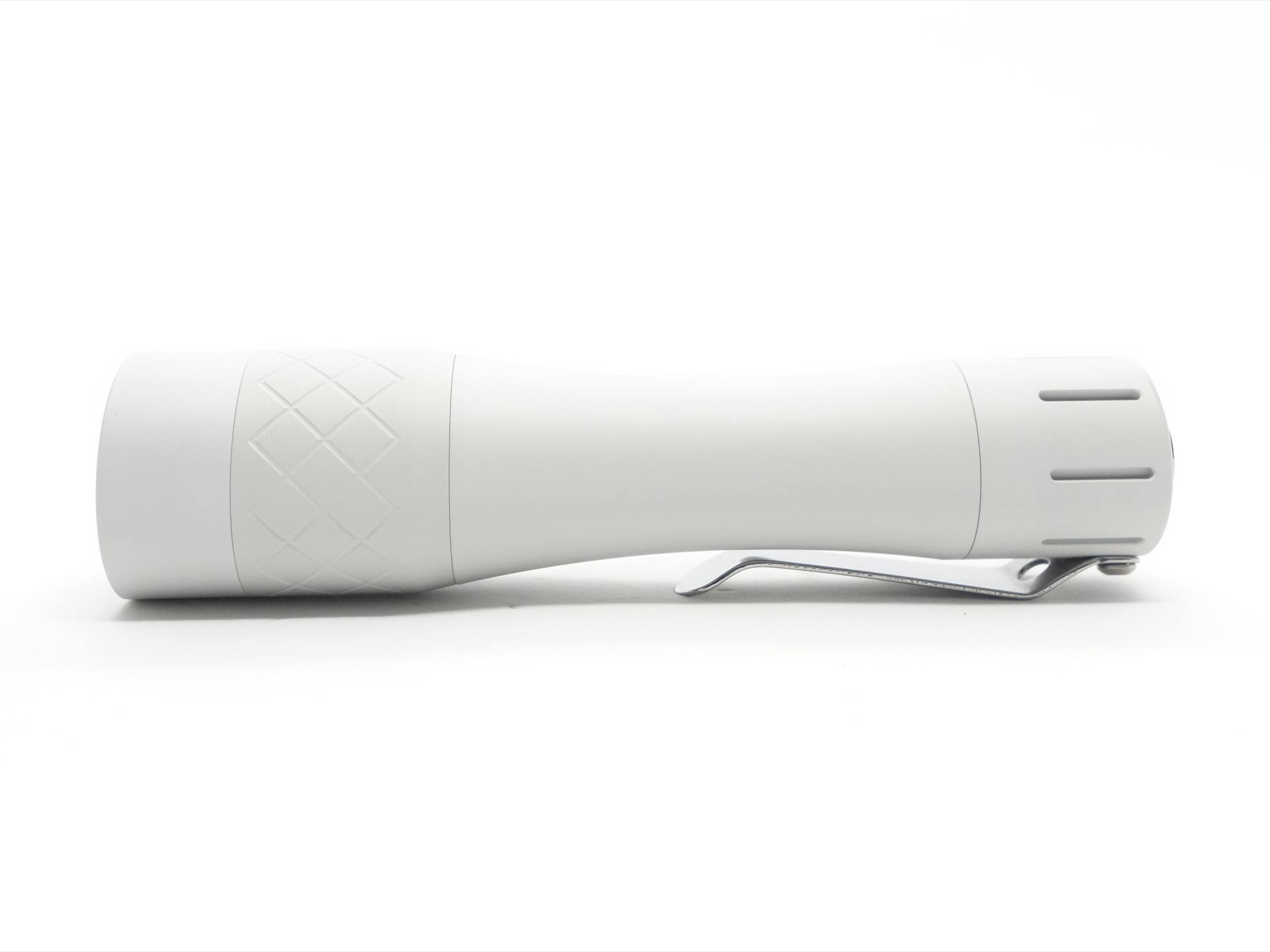
The NLIGHTD L3 MAO is comfortable to hold.
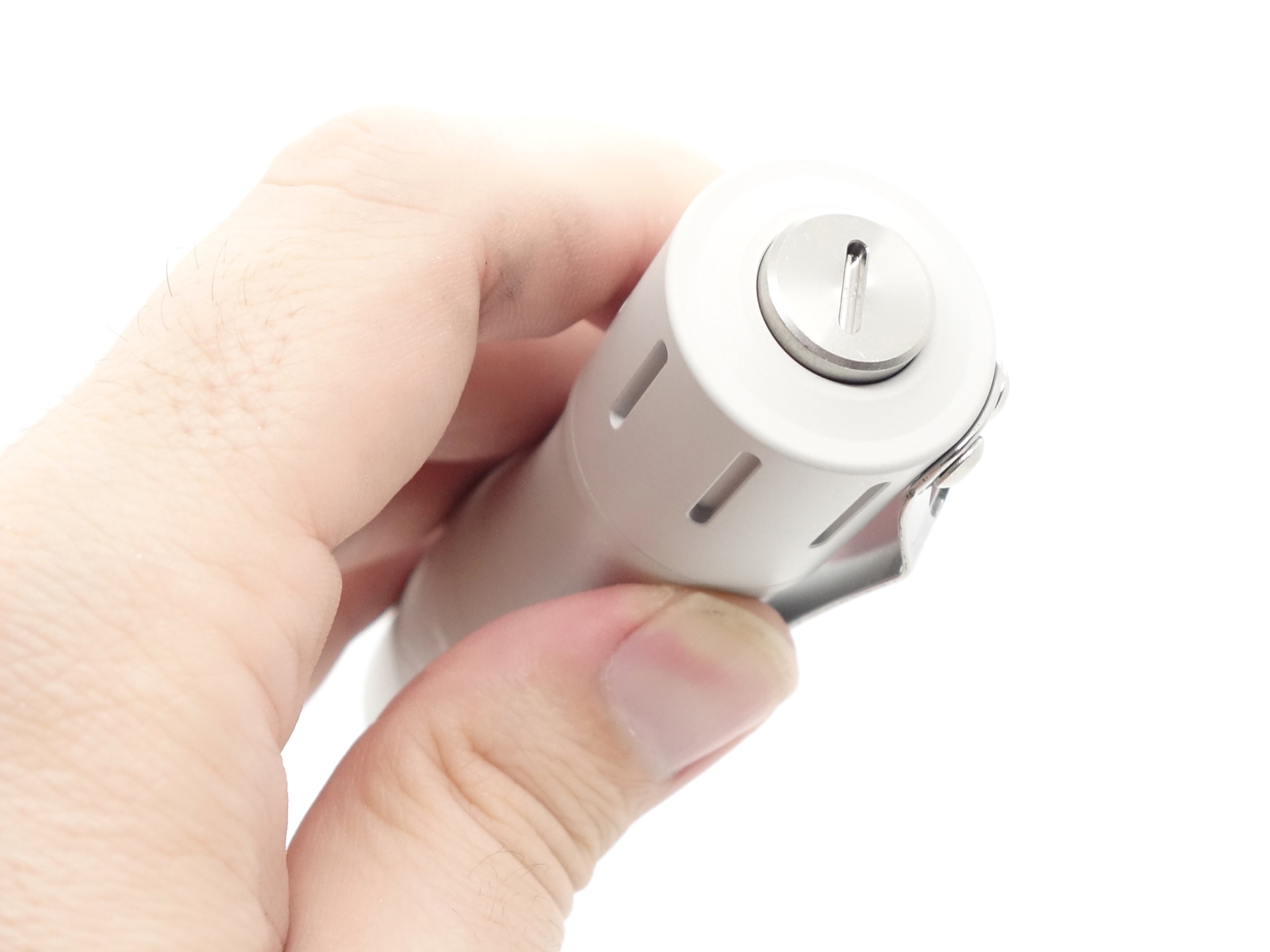
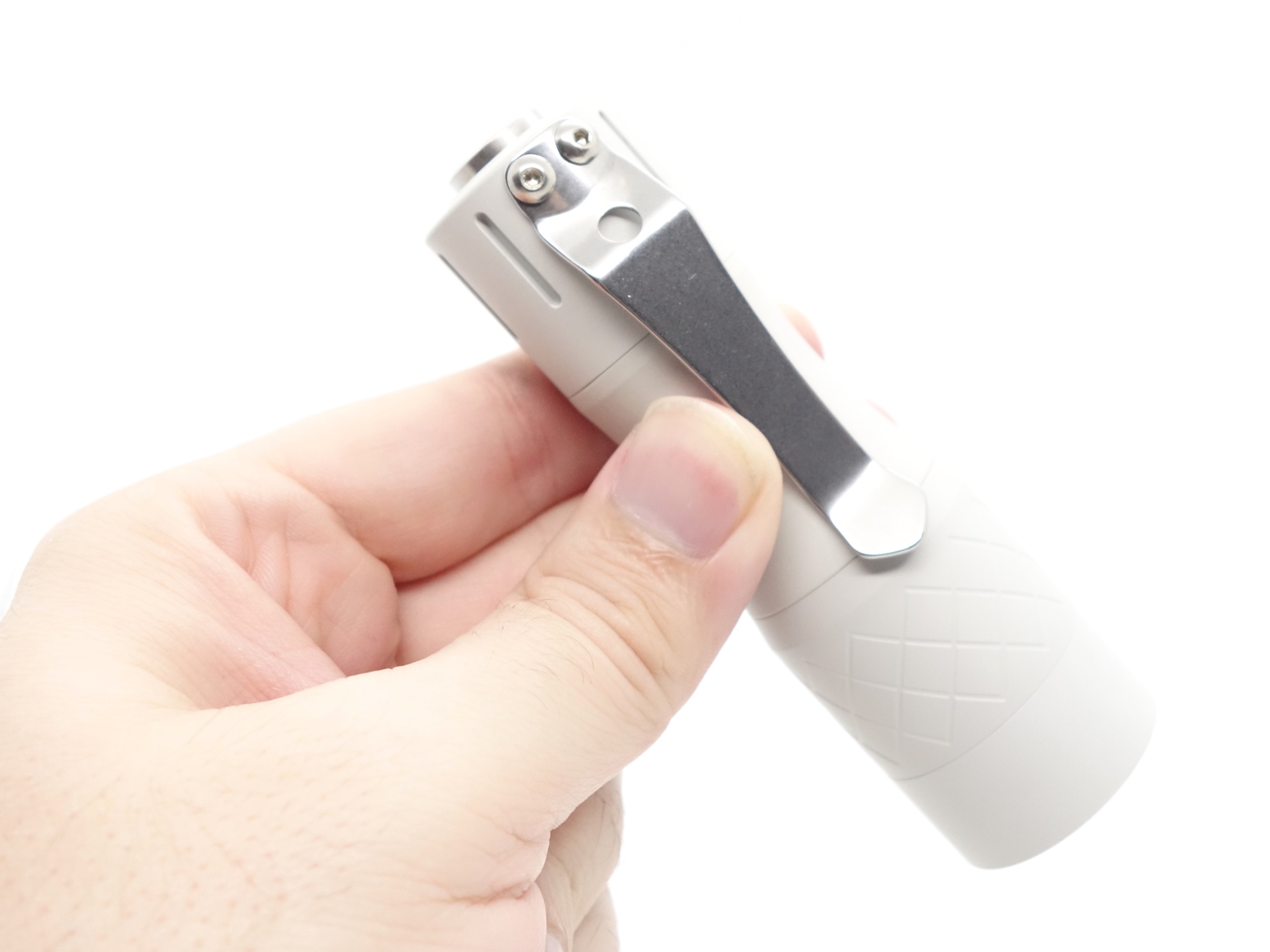
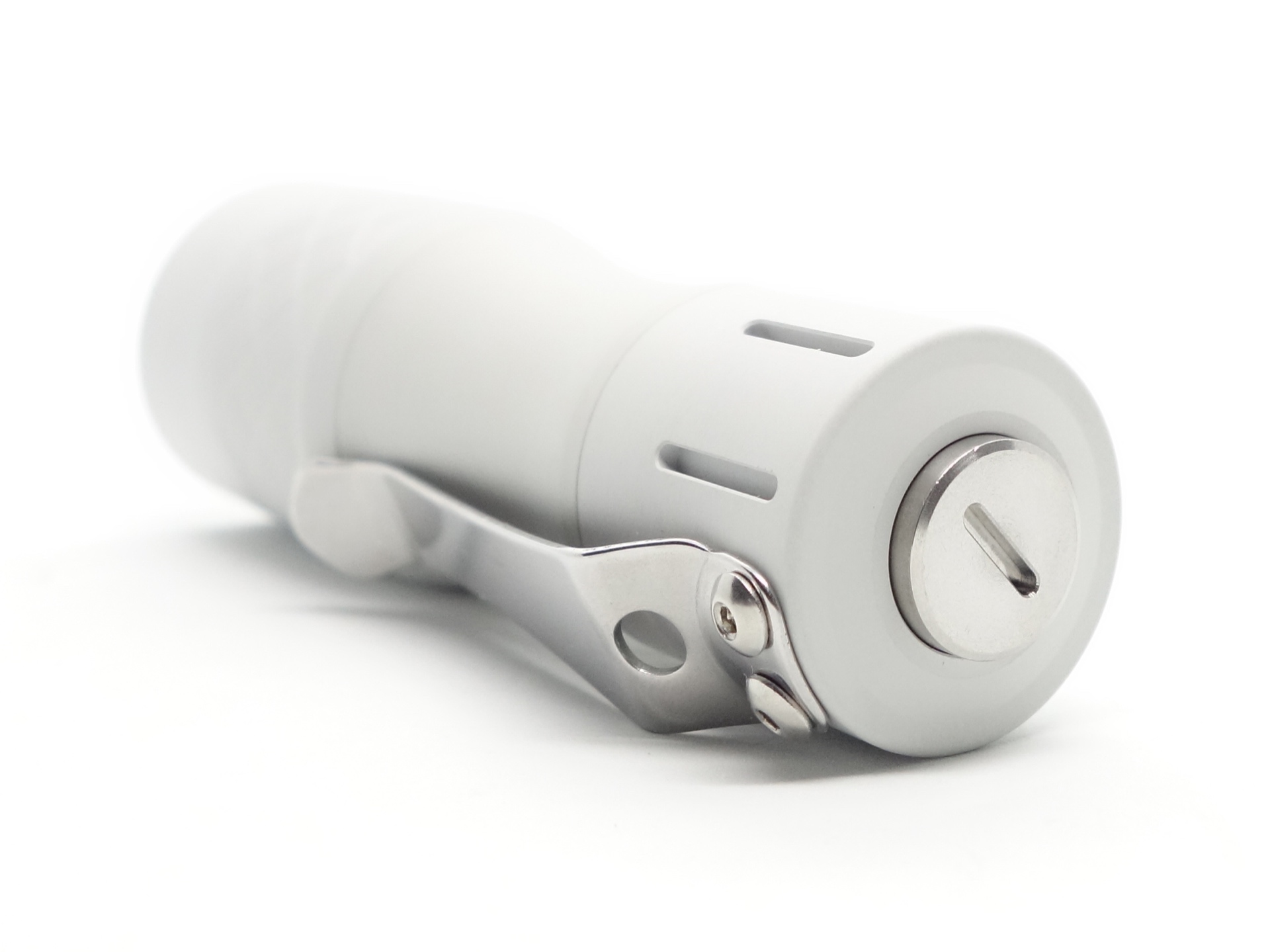
The tailcap has two screw holes for a pocket clip.
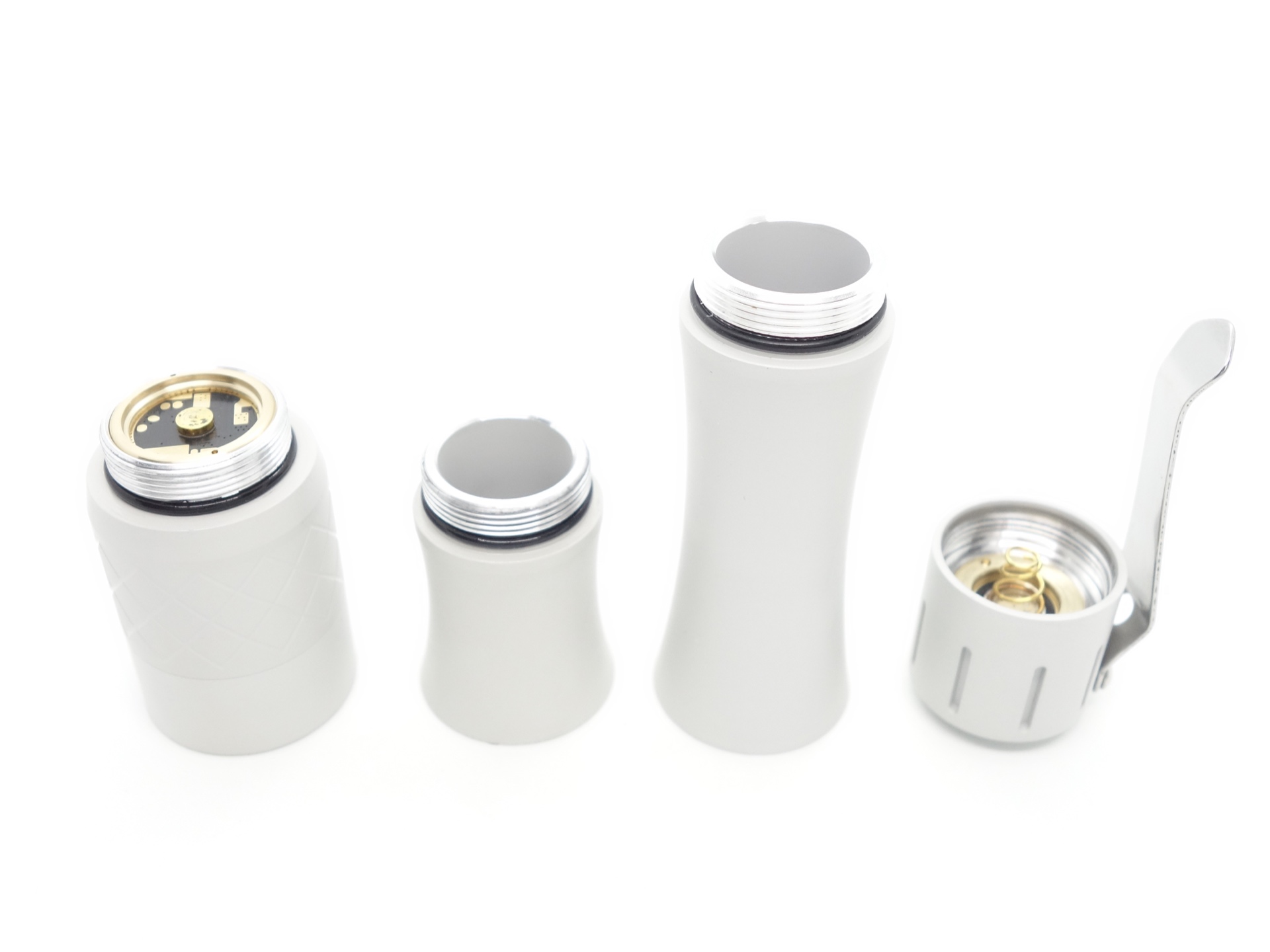
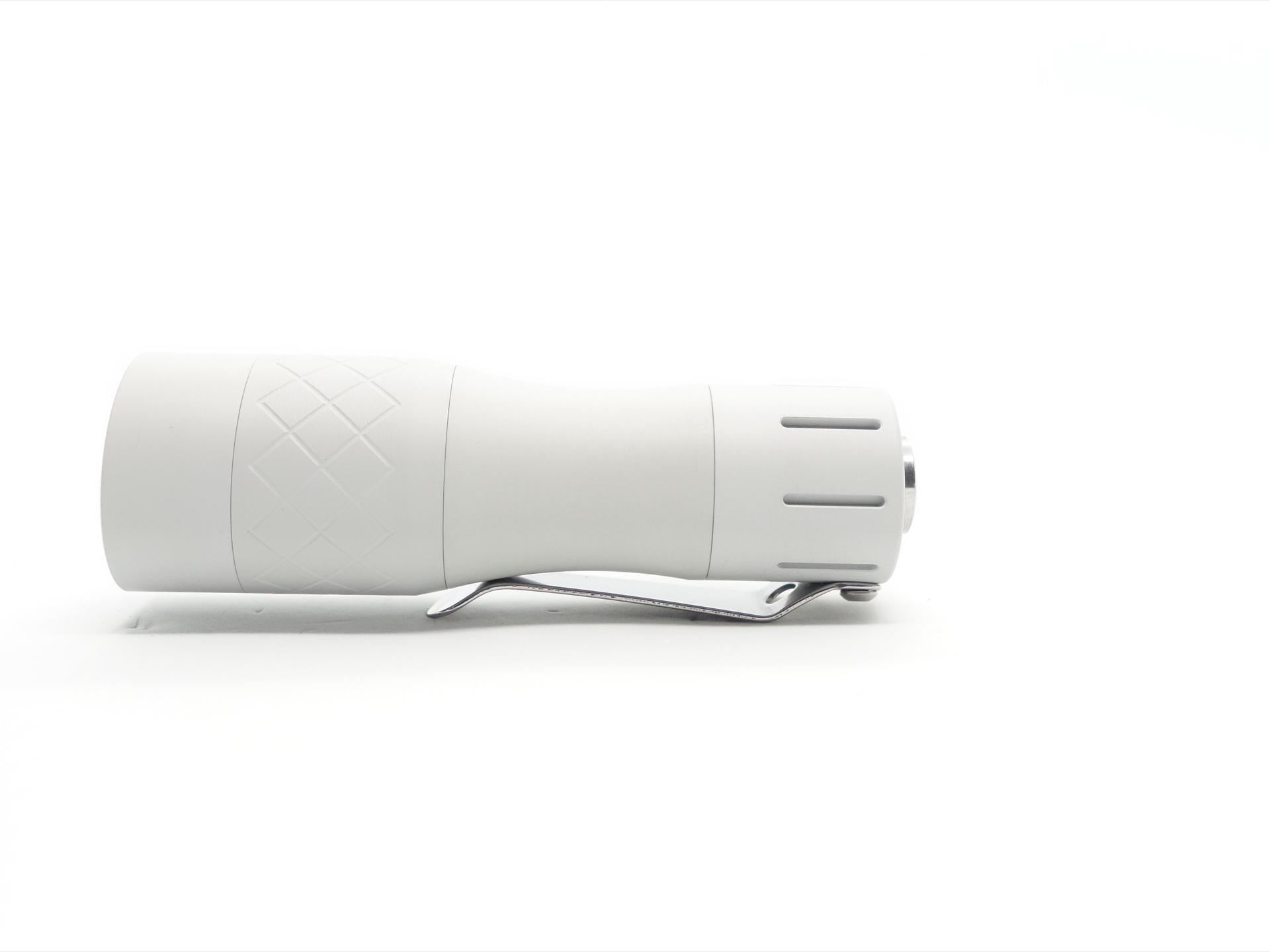
The NLIGHTD L3 MAO comes with an 18350 tube and an 18650 tube.
Build quality#
The body of this version of the NLIGHTD L3 MAO is made of aluminium and it has a white MAO finish (stains easily).
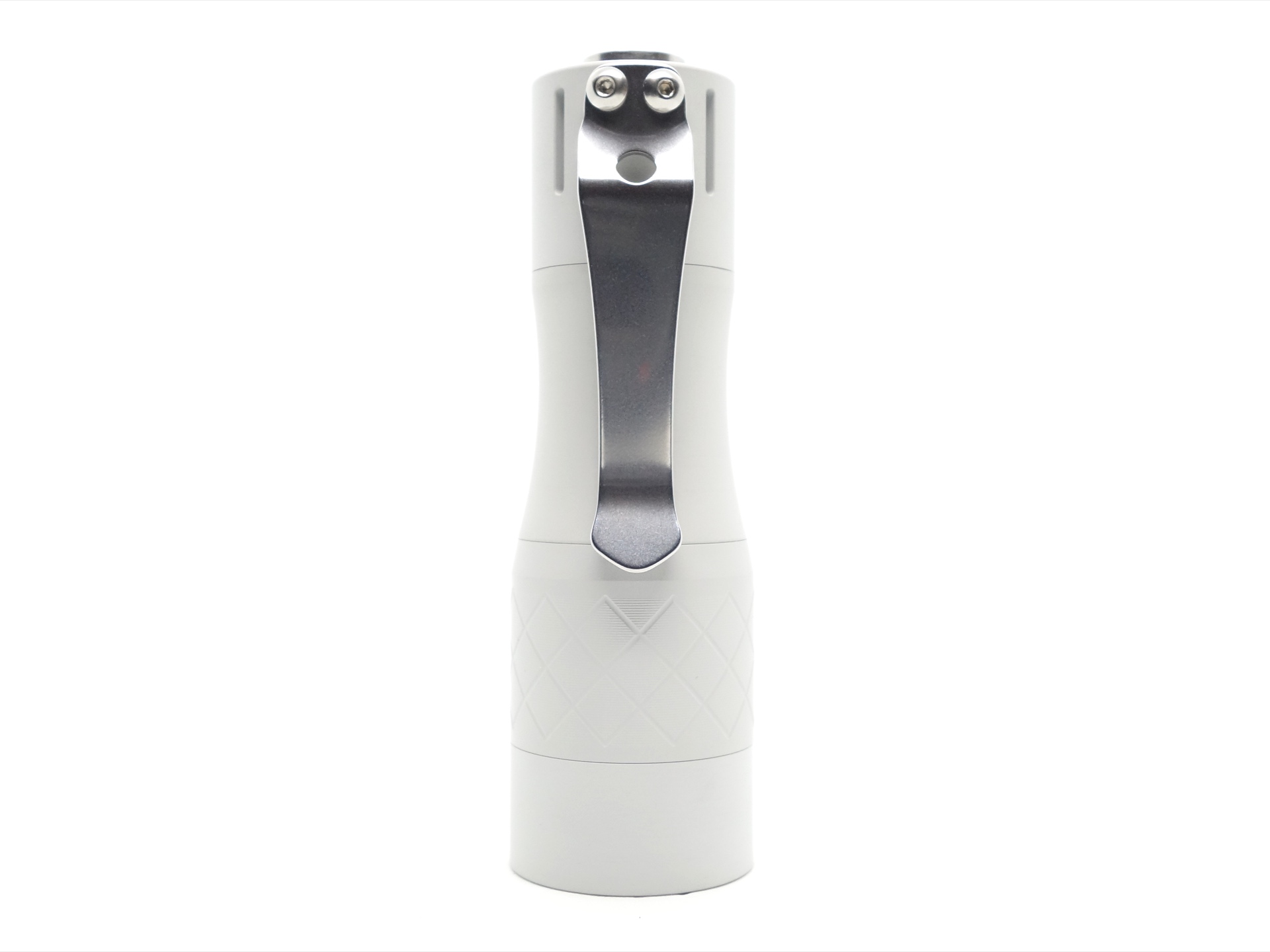
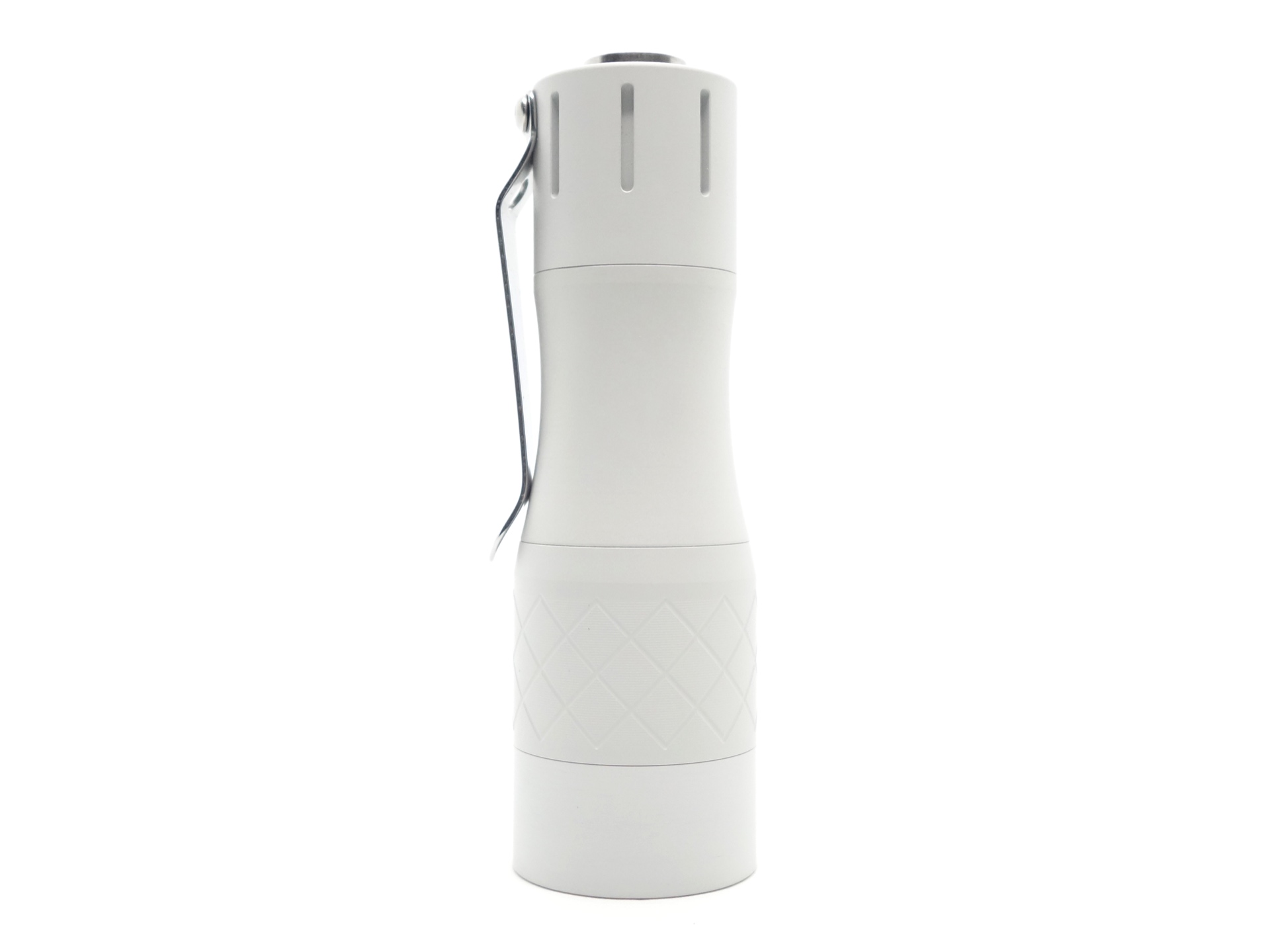
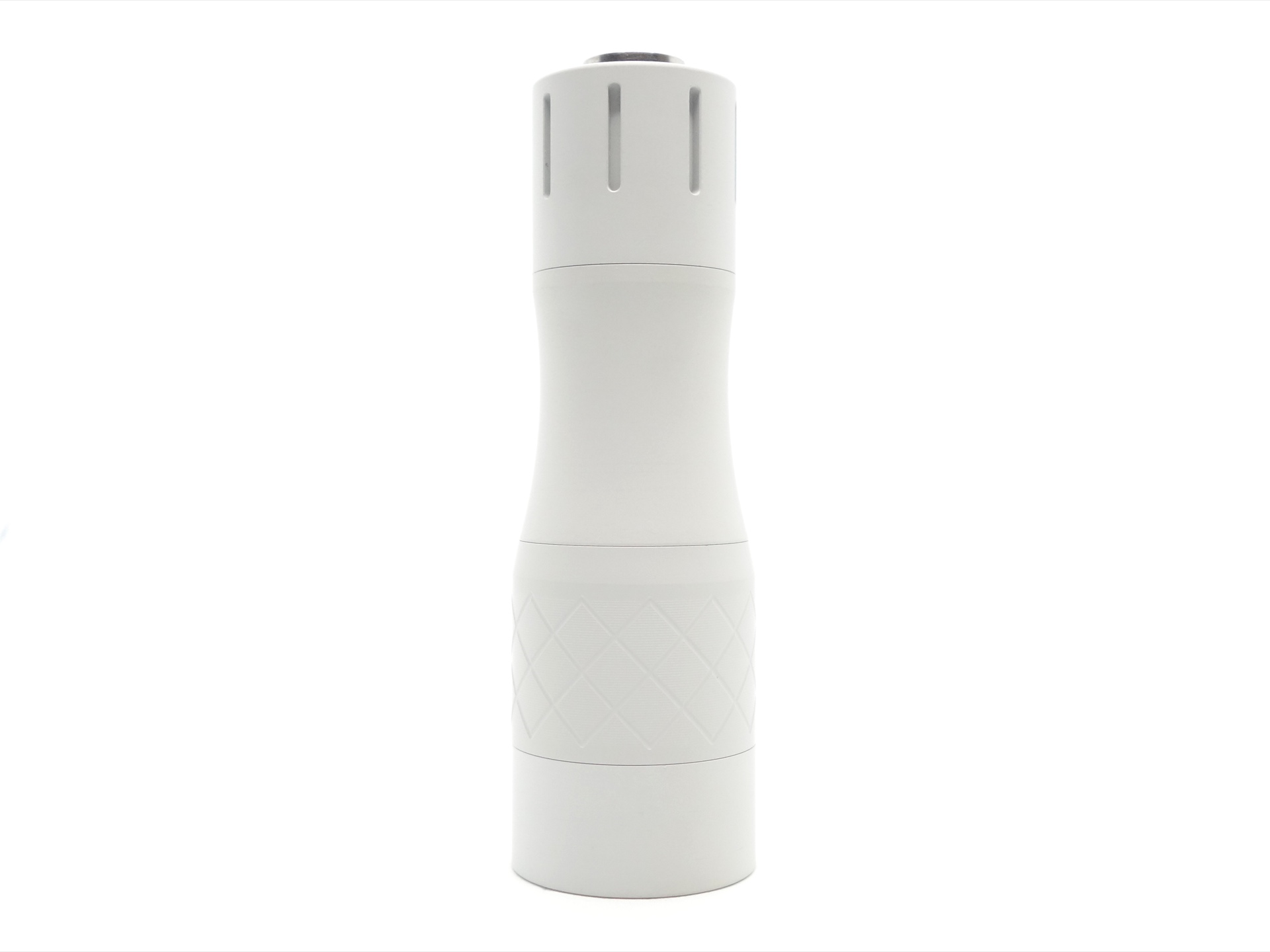
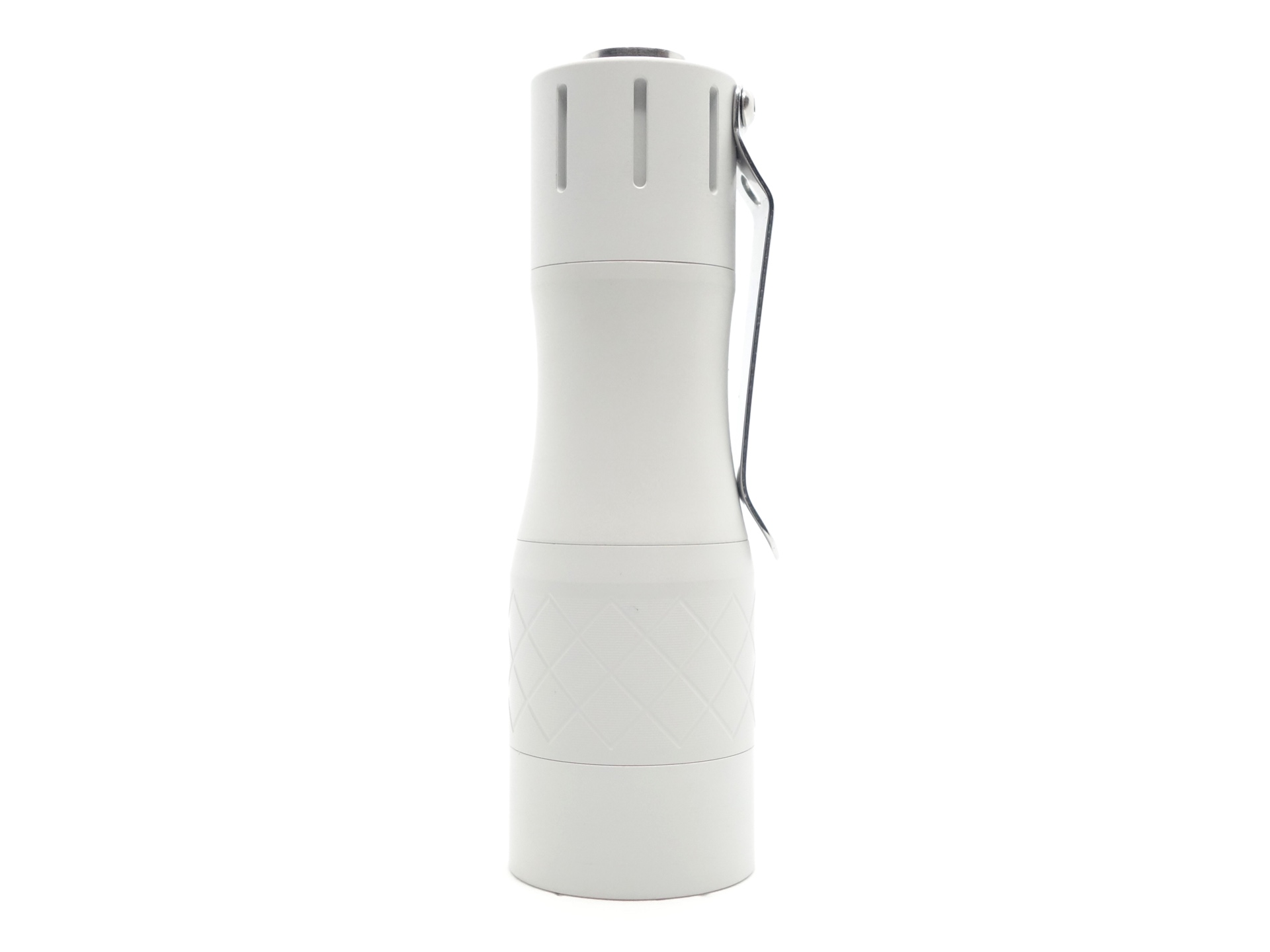
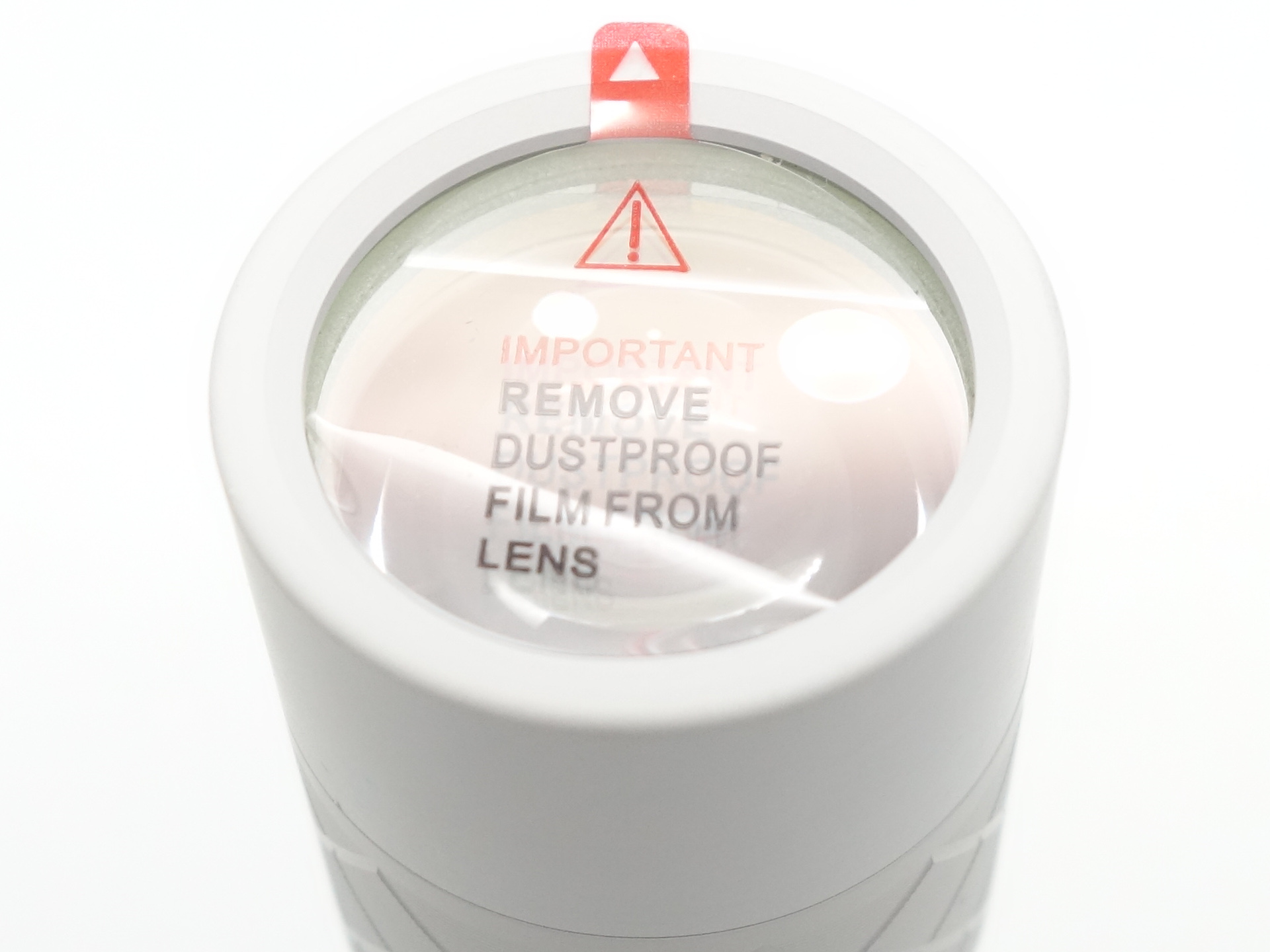
The torch arrived with protective film on the lens.
The torch feels smooth and there are no sharp edges.
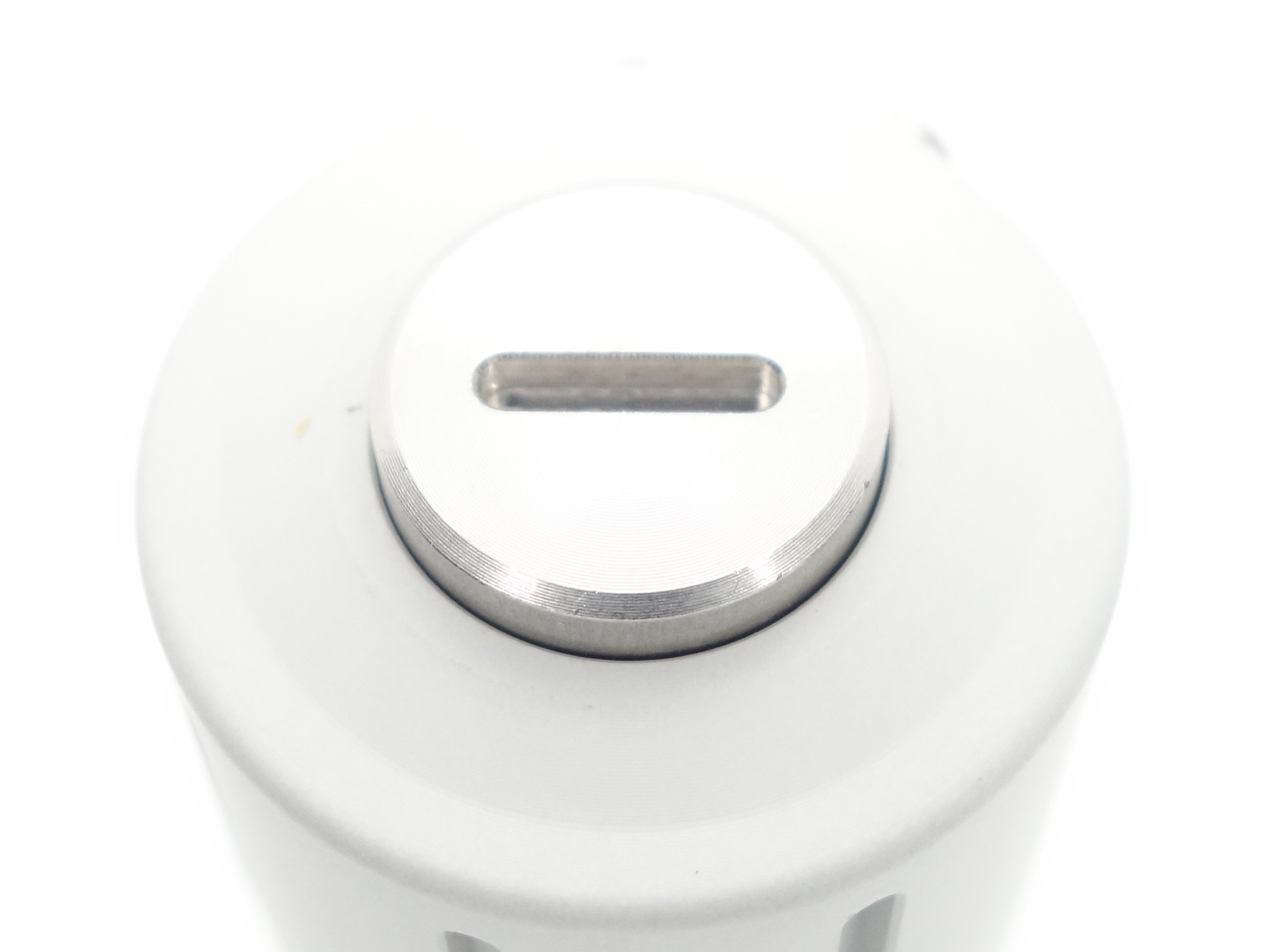
The tail switch feels firm initially when pressing down. The edges feel a bit mushy.
The pocket clip slides smoothly on my jeans.
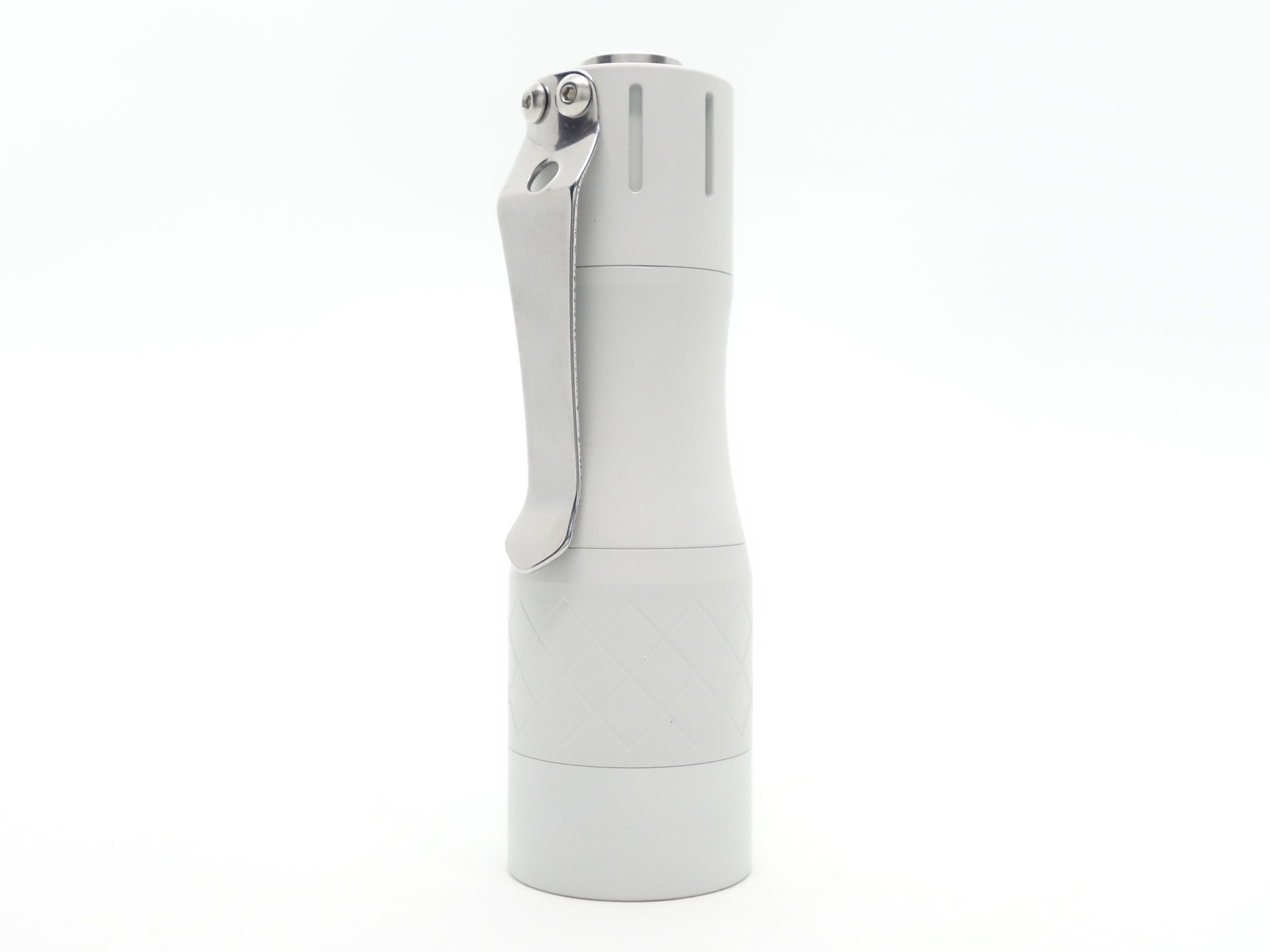
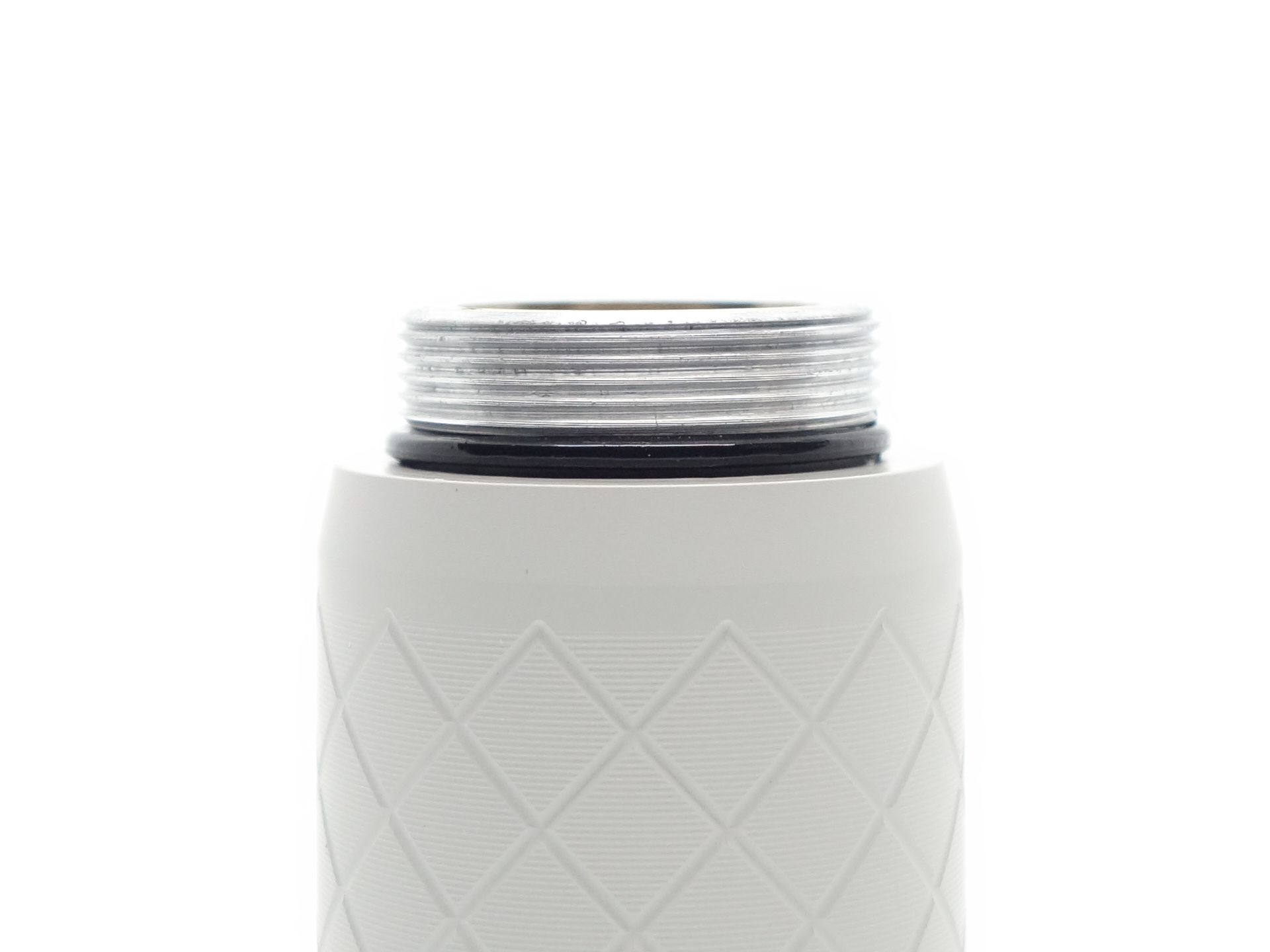
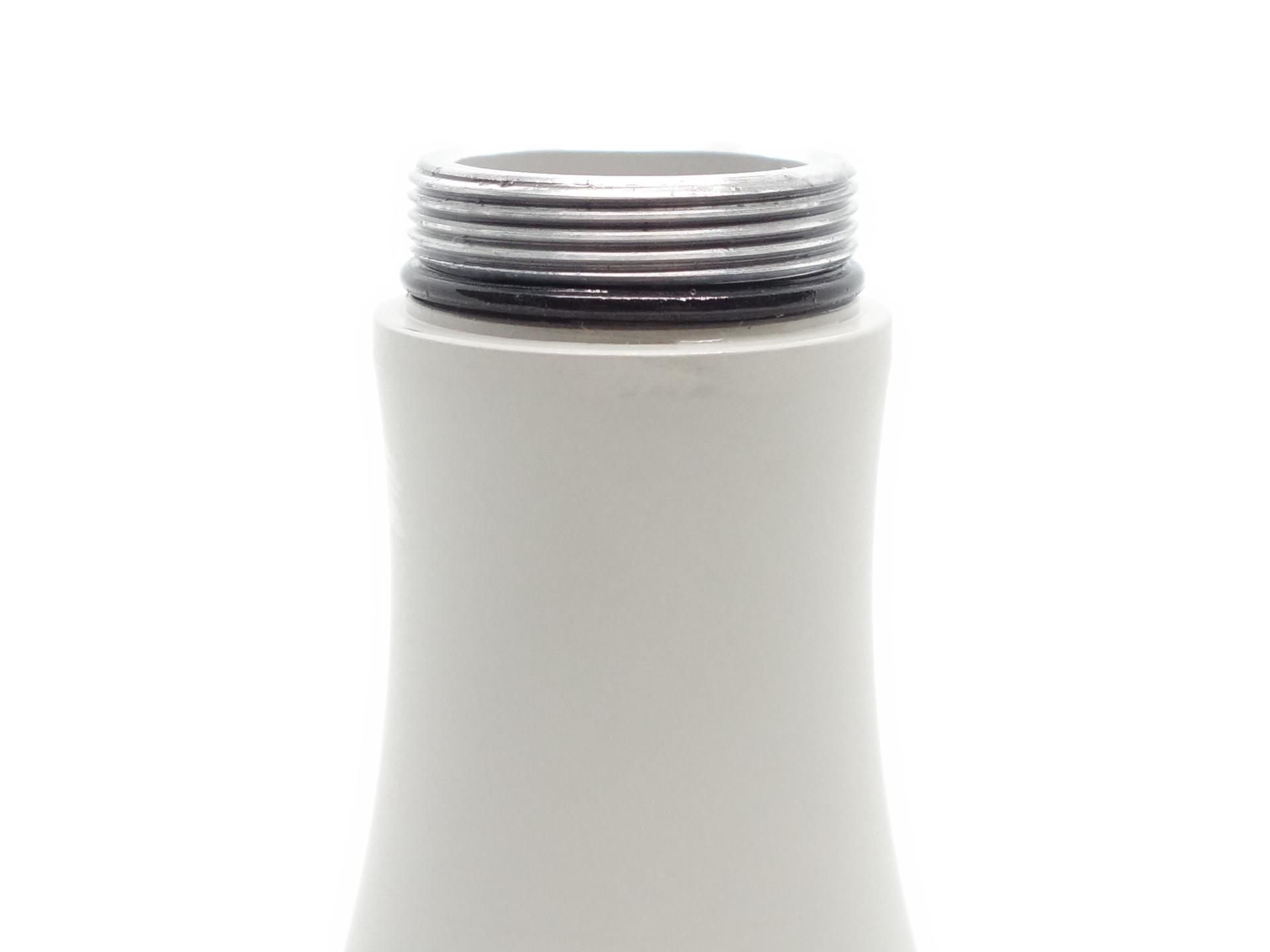
The threads feel gritty and they get dirty easily because the have not been anodised.
One good thing about the lack of anodising on the threads is that the torch can work with larger cells even if the tailcap has not been fully screwed onto the tube.
It would be nice if the threads were anodised so that you can lock the torch by doing a quarter turn.
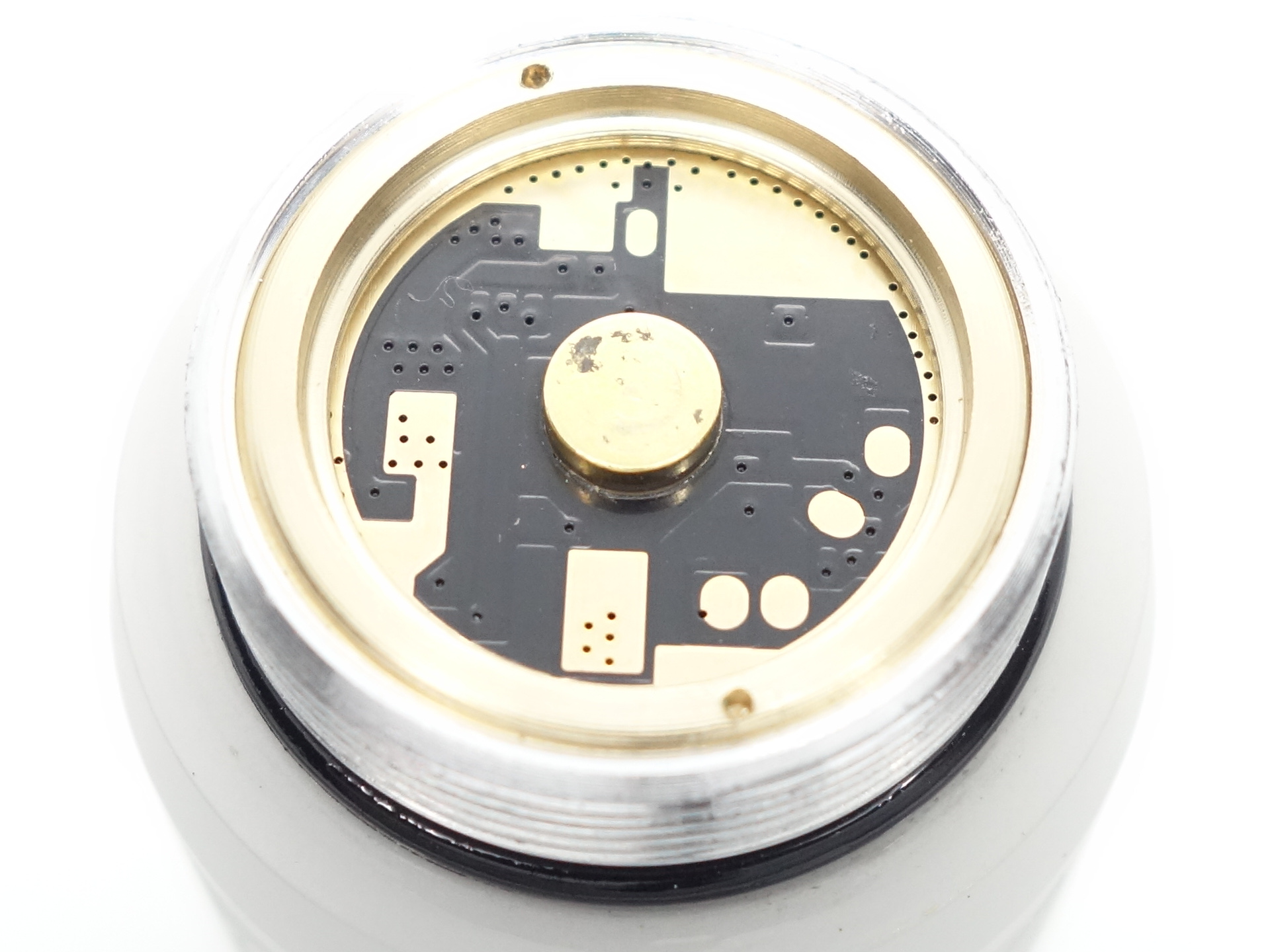
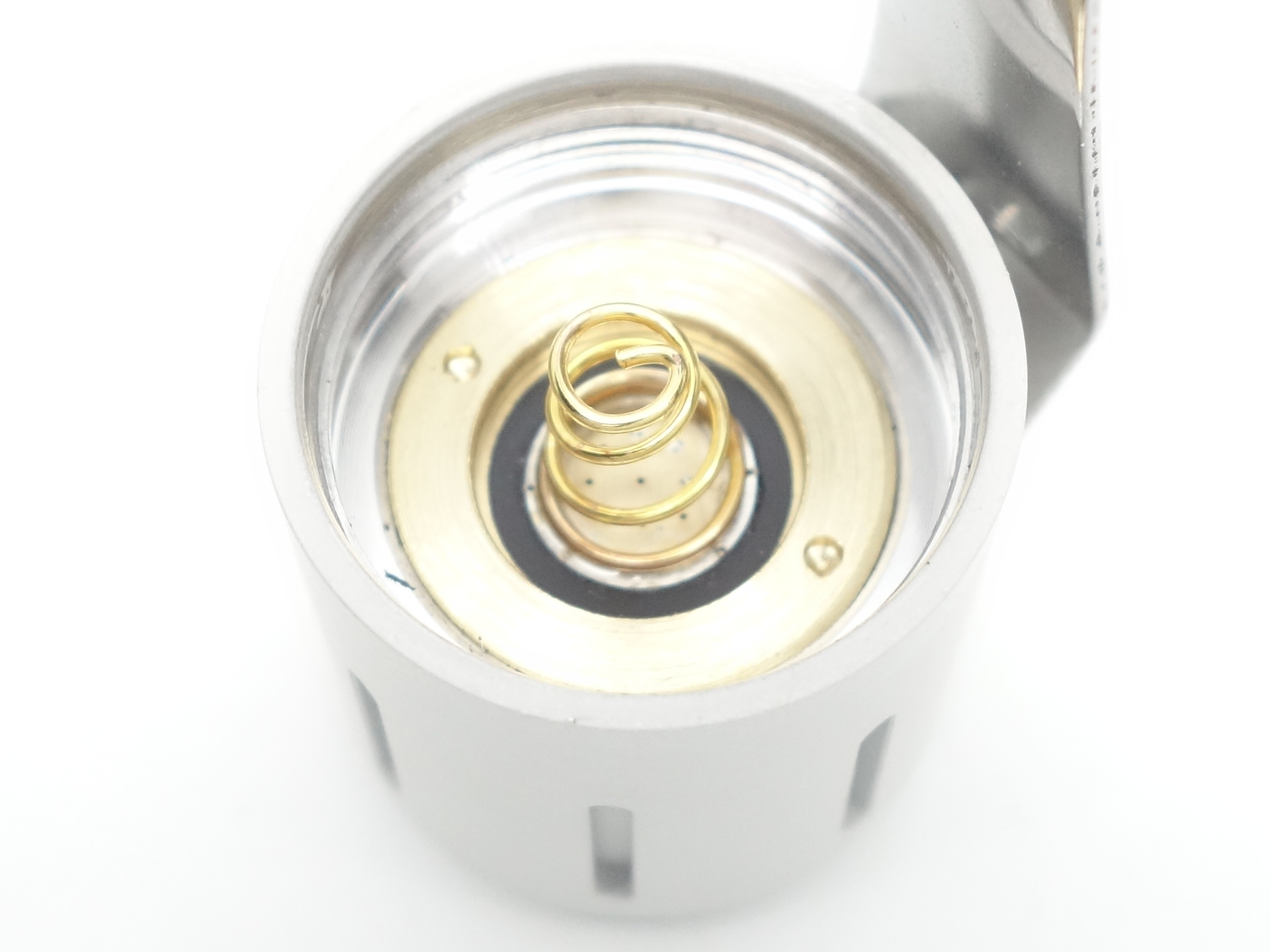
The driver has a big notch that prevents long 18650 and 18350 cells from fitting. Flat top cells and button top cells without built-in USB-C charging fit.
LED, bezel, lens, reflector and beam#
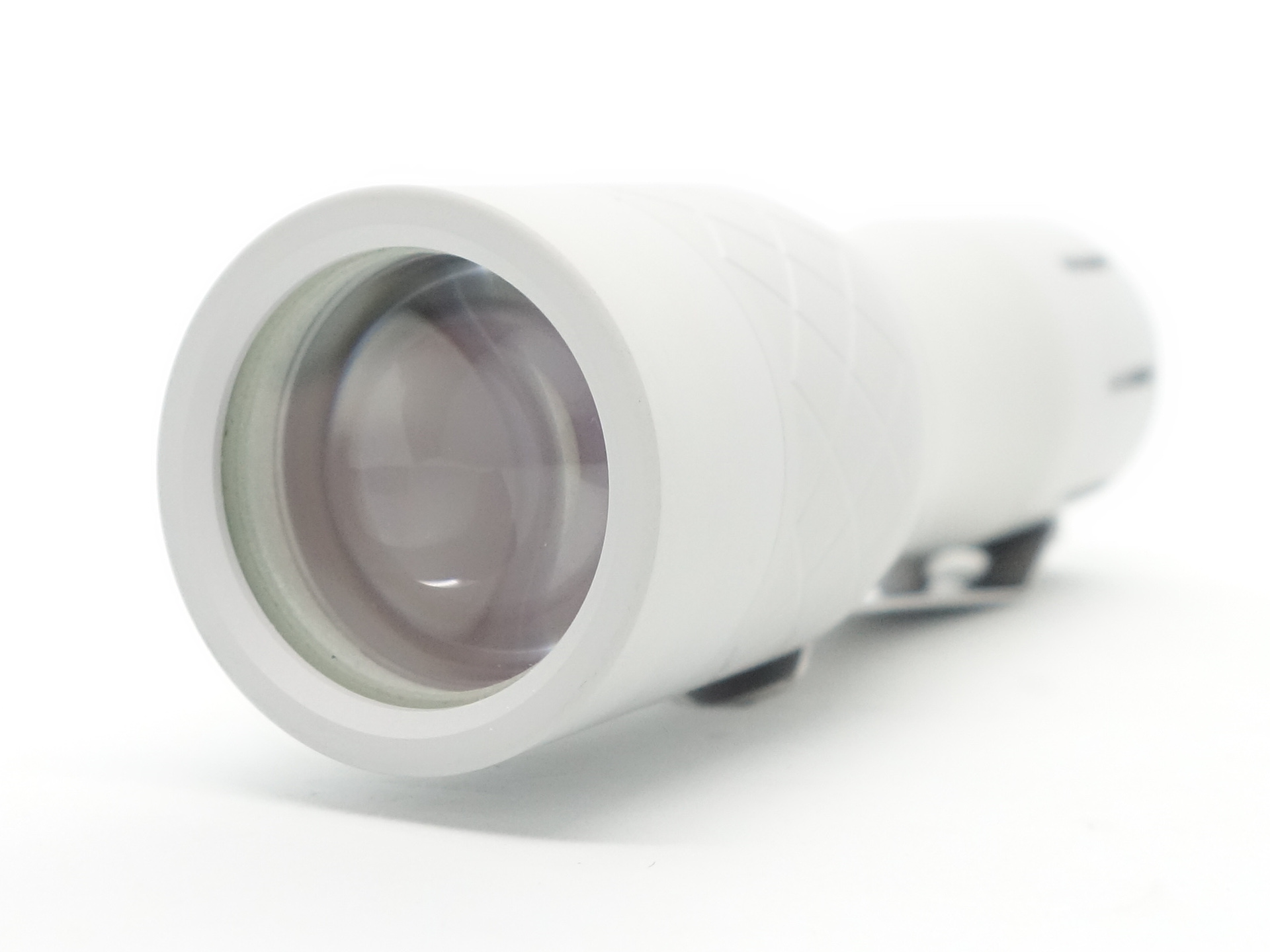
The NLIGHTD L3 MAO has a 15W shine-through LEP module.
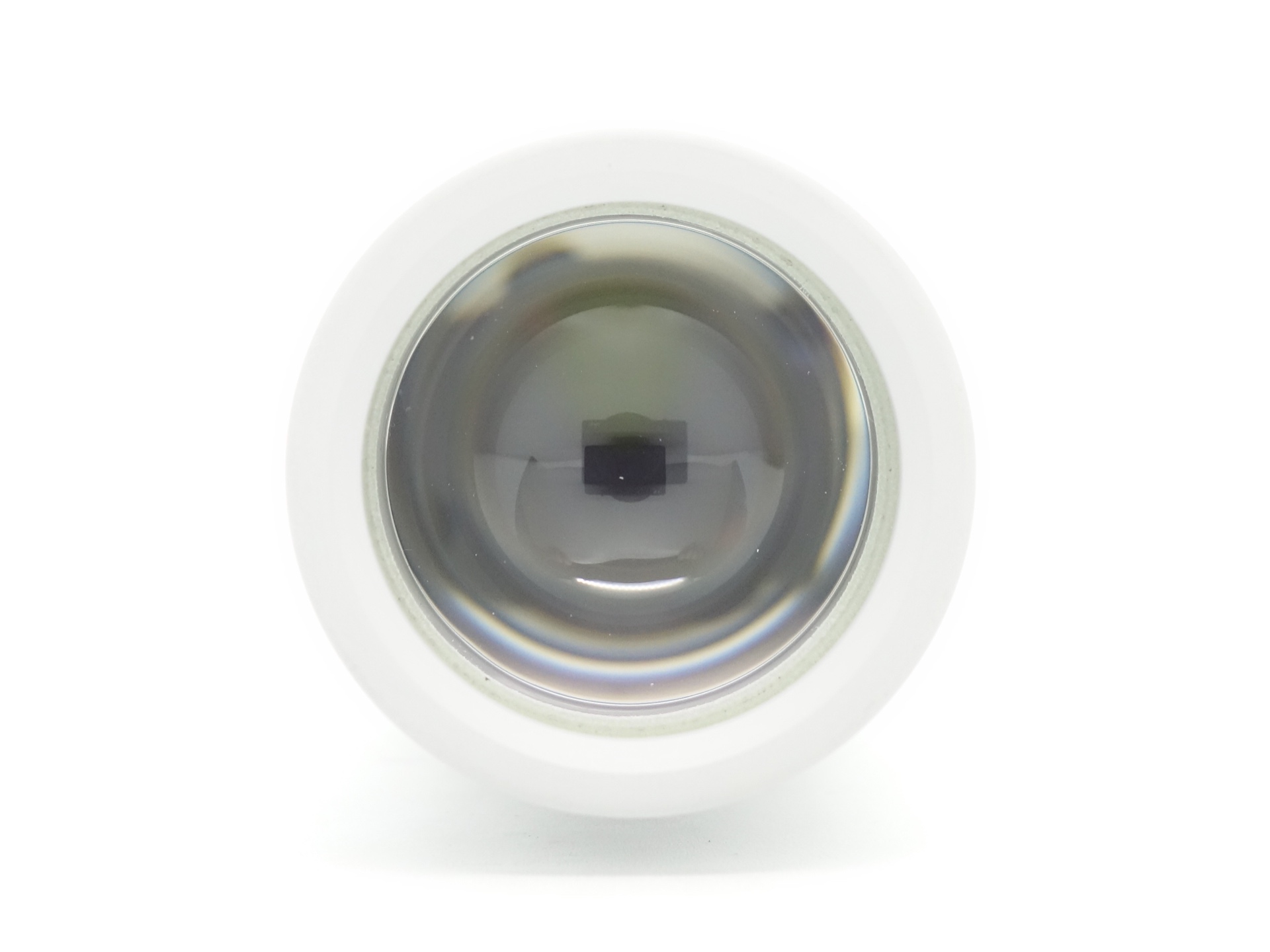
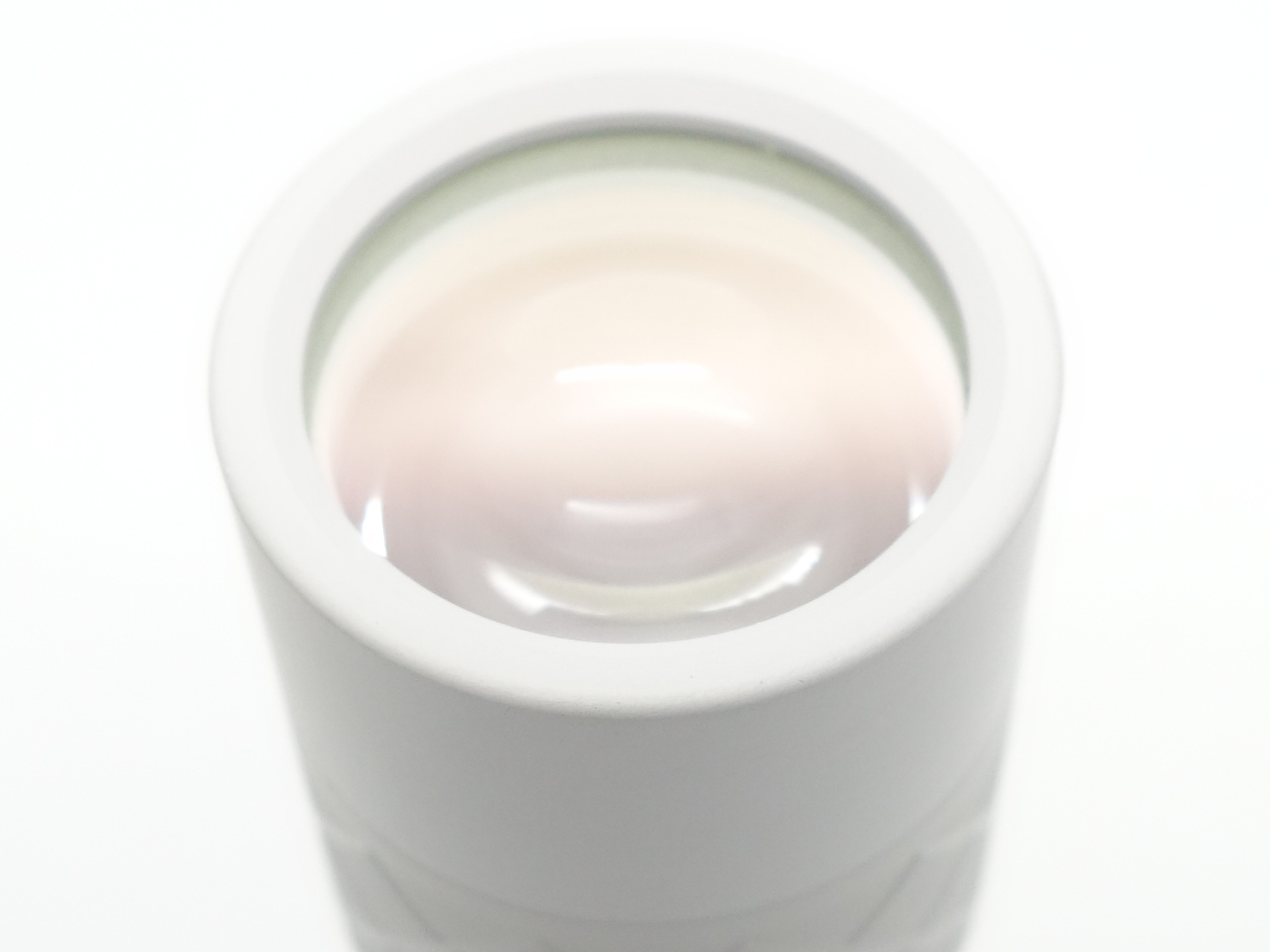
There is a glass lens with an anti-reflective coating sitting on top of a blue glow-in-the dark ring.
Teardown#
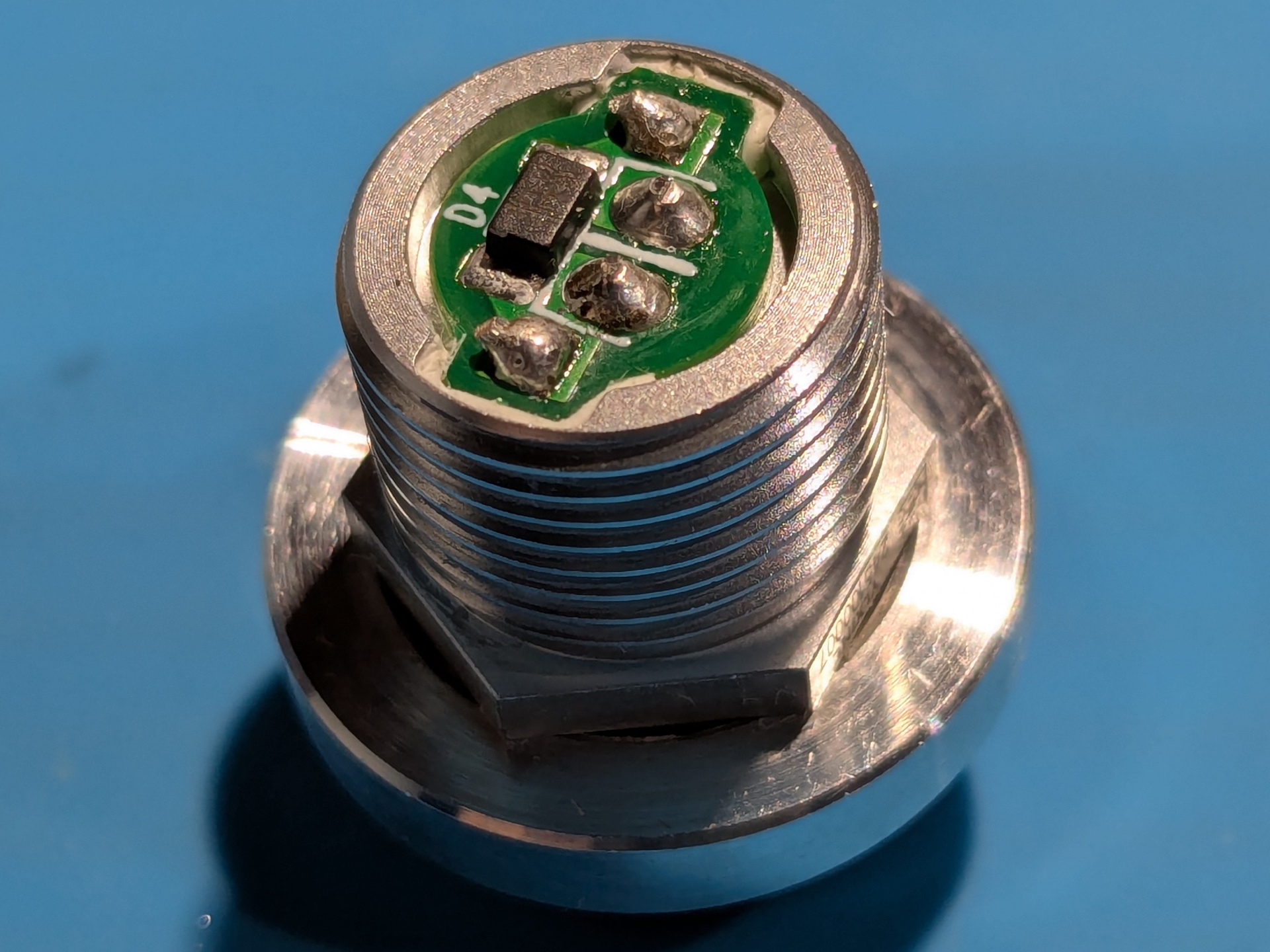
The bezel can be unscrewed easily.
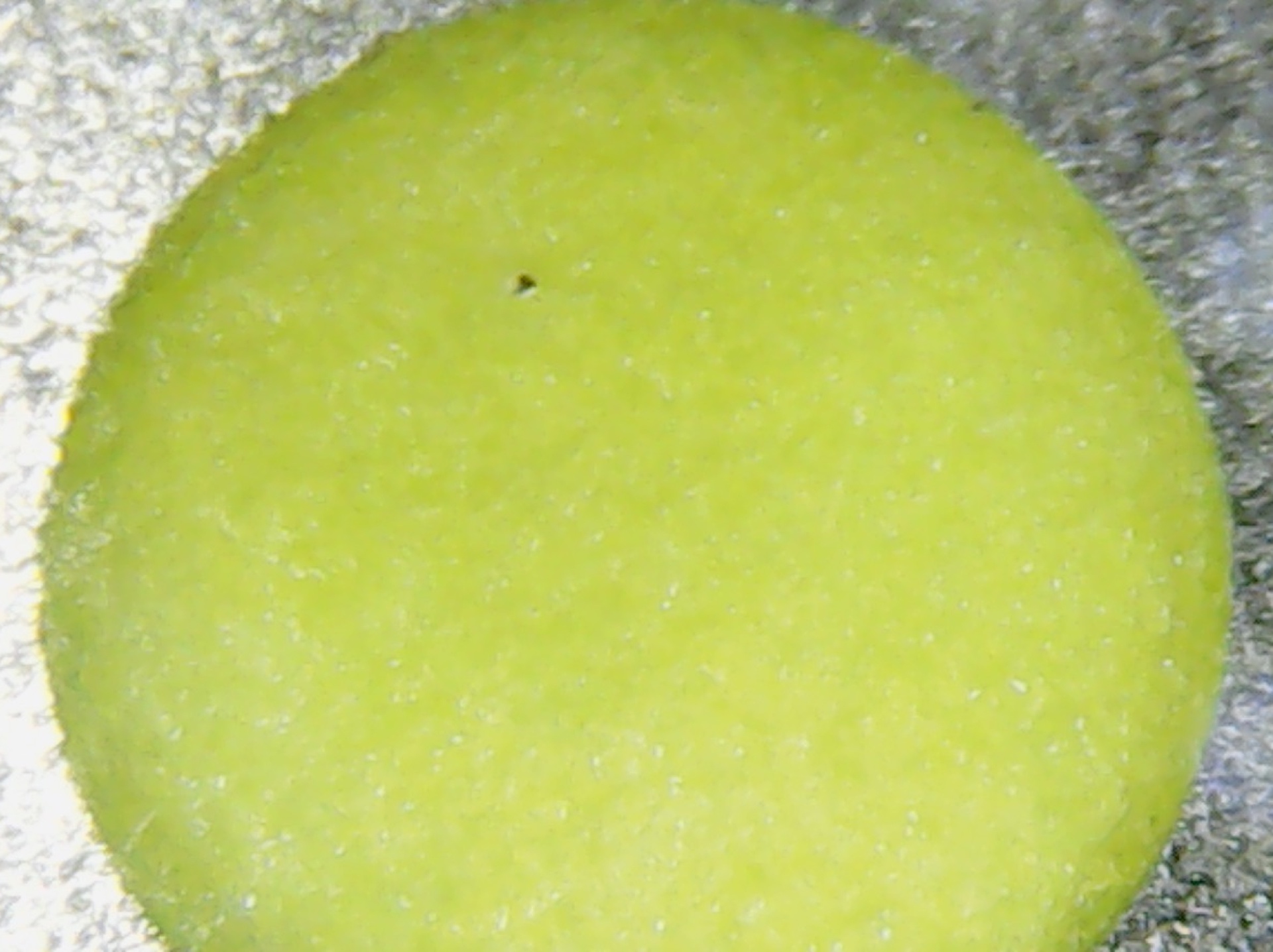
After noticing a “donut” shape gradually appear after a few minutes in the beam I decided to look at the LEP module more closely.
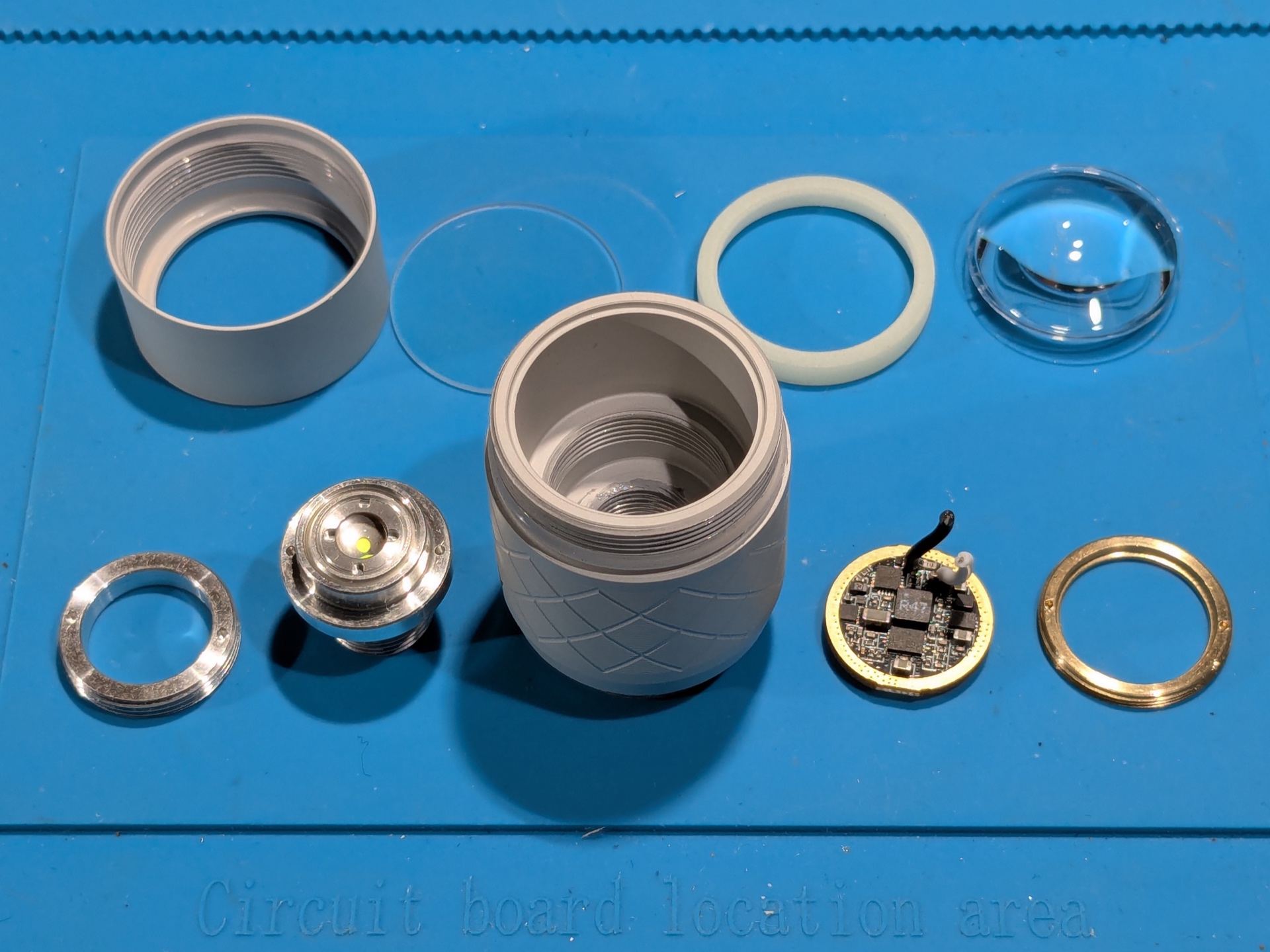
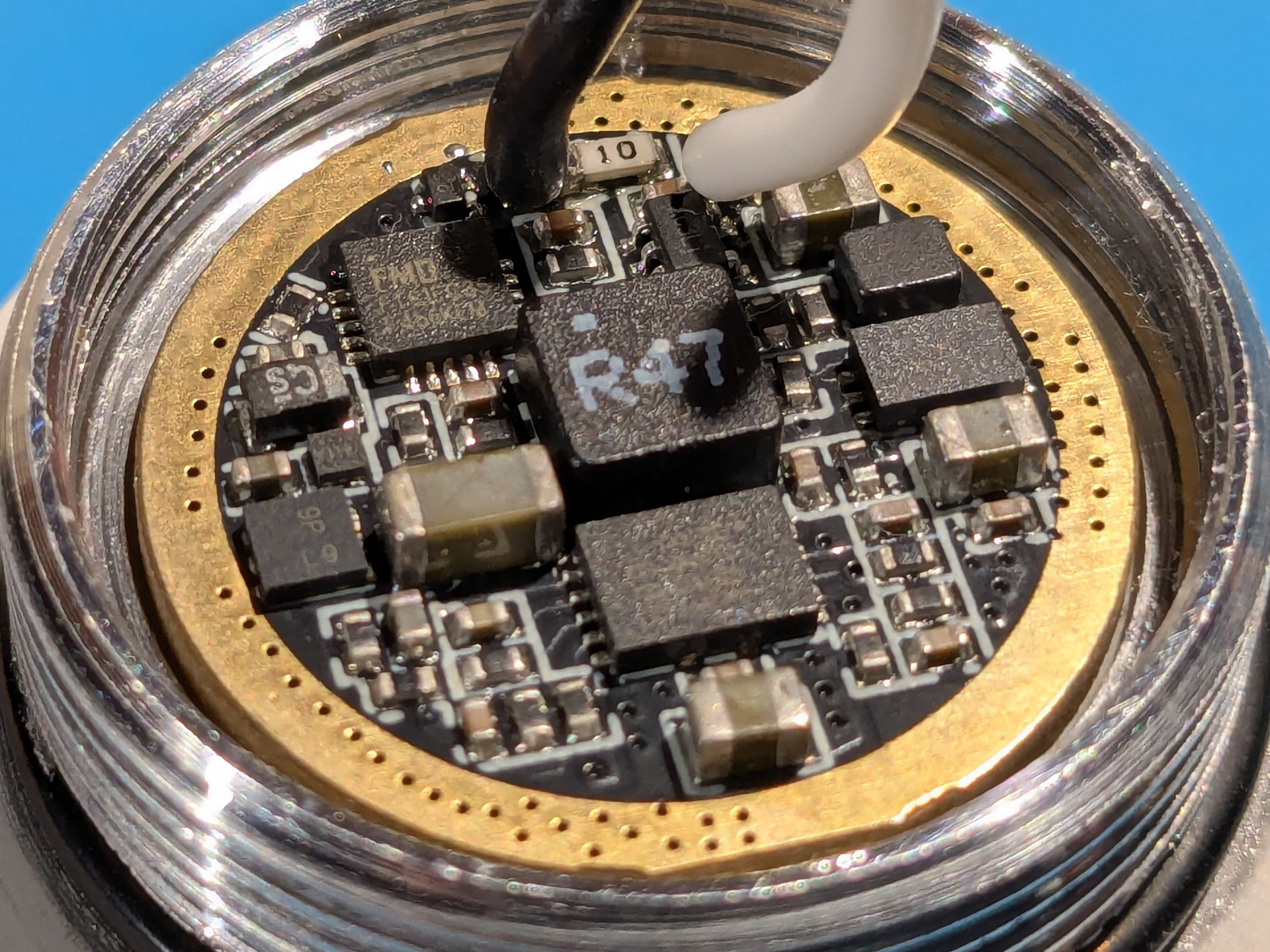
I could not see anything wrong with the LEP module so I bought a digital microscope to inspect the yellow phosphor.
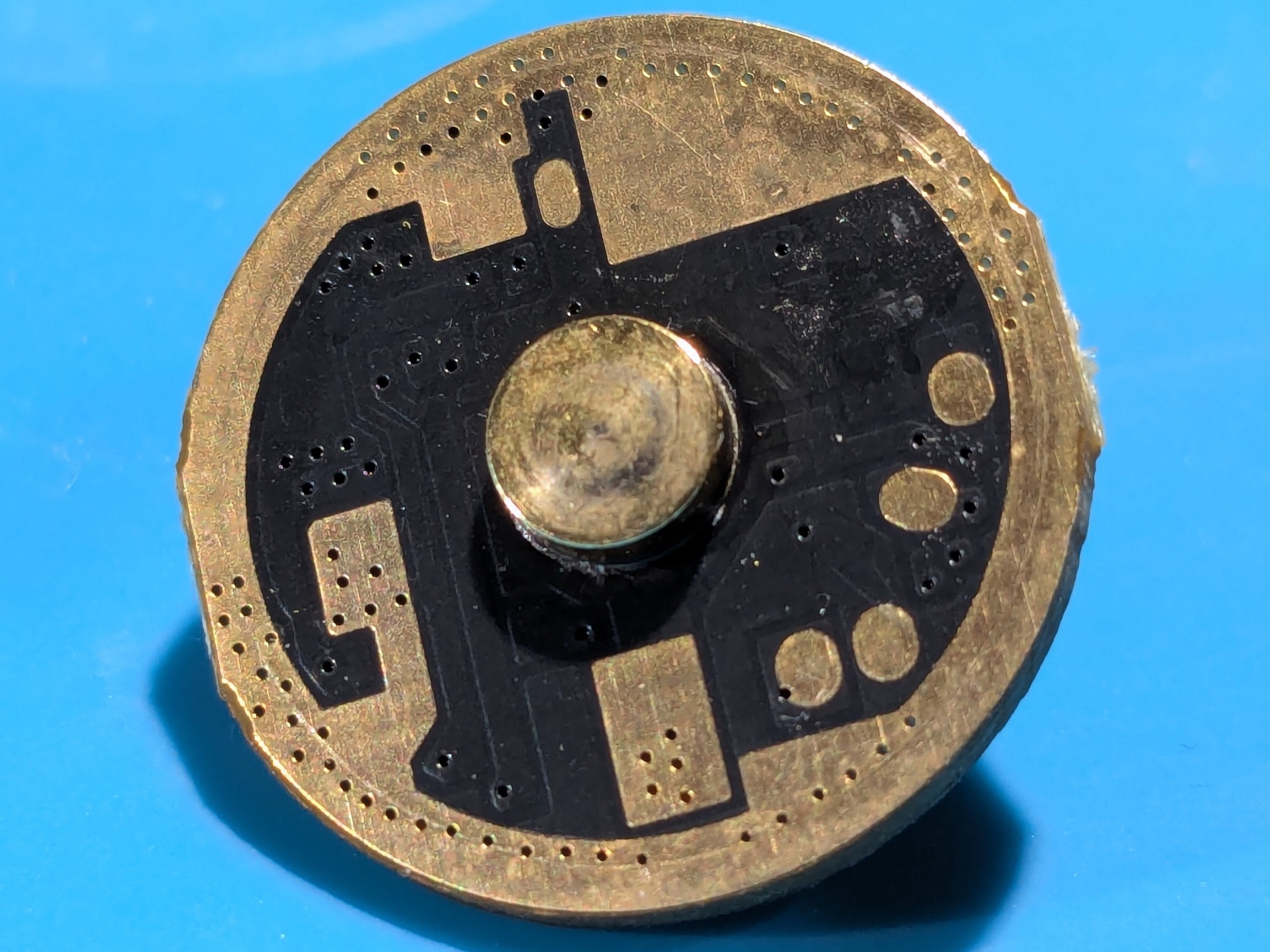
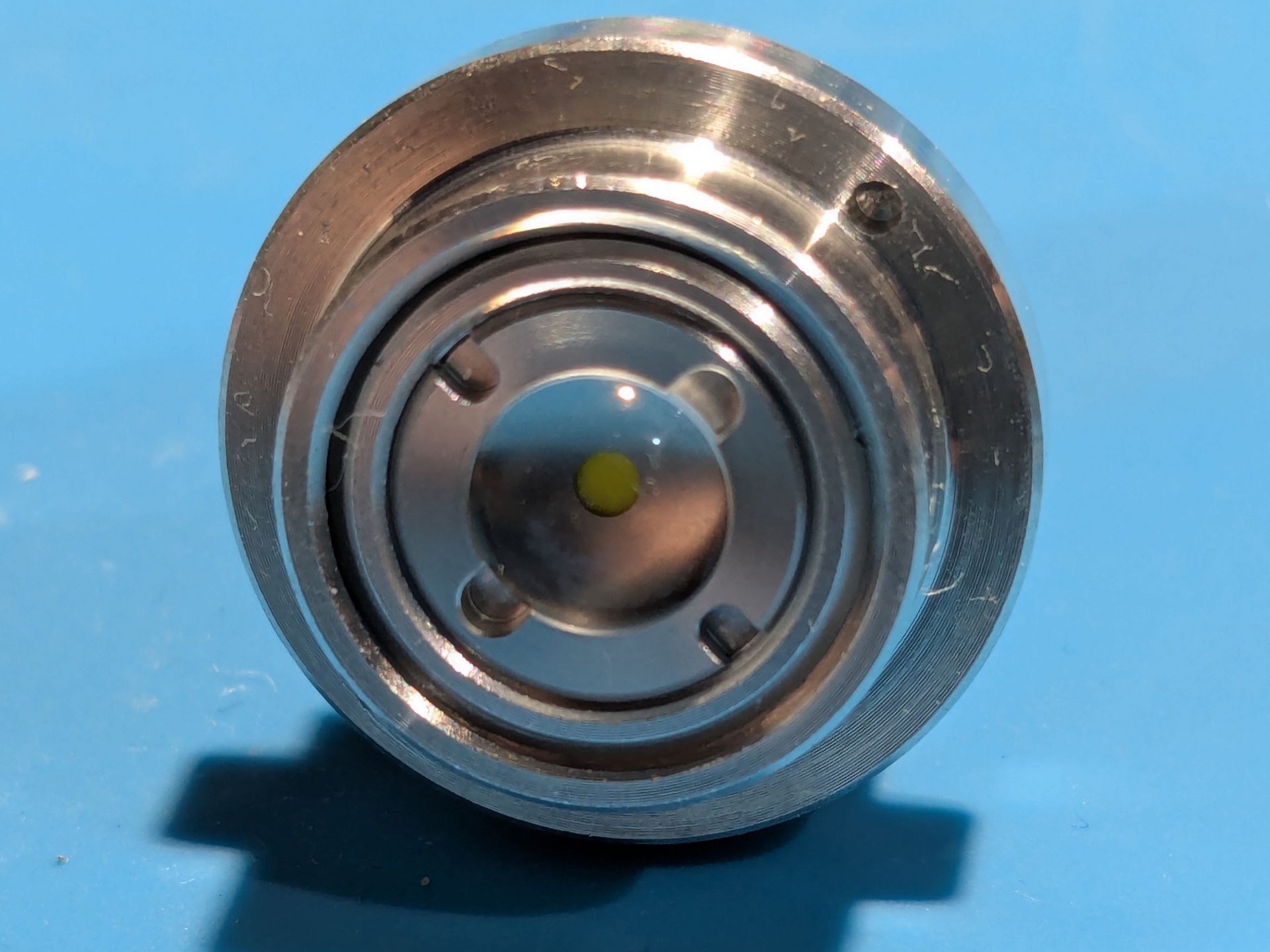
There is a small black dot on the yellow phoshor. This might be due to the high current being used. It could also happen when the lens is slightly out of alignment.
CCT, CRI, and duv#
These measurements are from the NLIGHTD L3 prototype.
I have taken Correlated Colour Temperature (CCT) and Colour Rendering Index (CRI, RA of R1-R8) measurements with the NLIGHTD L3 prototype positioned ten metres away from an Opple Light Master Pro III (G3). I measured the centre of the beam.
The CCT is around 10000K, the CRI is around 72 and the Delta u, v is slightly negative. I would not call the beam rosy or green. There is a bit of yellow tint shift in the beam due to the lens.
The beam produced has an extremely intense hot spot with minimal spill. Despite having a shine-through LEP module, there is a bit of tint shift.
| Mode | CCT (K) | CRI (Ra) | x | y | Duv |
|---|---|---|---|---|---|
| Low | 9175 | 71.9 | 0.2855 | 0.2932 | -0.0004 |
| High | 10735 | 72.4 | 0.2793 | 0.2770 | -0.0052 |
Calculate Duv from CIE 1931 xy coordinates
Dimensions and size comparison#
Dimensions#
I took the following measurements using a digital caliper.
| Measurement | Unit (mm) |
|---|---|
| Length with 18650 | 141 |
| Length with 18350 | 108.2 |
| Head diameter | 33 |
| Tail diameter | 27.56 |
| Button diameter | 13.86 |
| Tritium slot | 1.6 * 1.6 * 13.5 |
Weight#
I took the following measurements using a digital scale.
| Weight | Unit (g) |
|---|---|
| NLIGHTD L3 MAO with 18650 tube | 153.4 |
| NLIGHTD L3 MAO with 18350 tube | 137.0 |
| 18650 cell | 47.4 |
| 18350 cell | 24.3 |
| NLIGHTD L3 MAO with 18650 | 200.8 |
| NLIGHTD L3 MAO with 18350 | 161.3 |
I measured the weight with the pocket clip.
Size comparison with its competition#
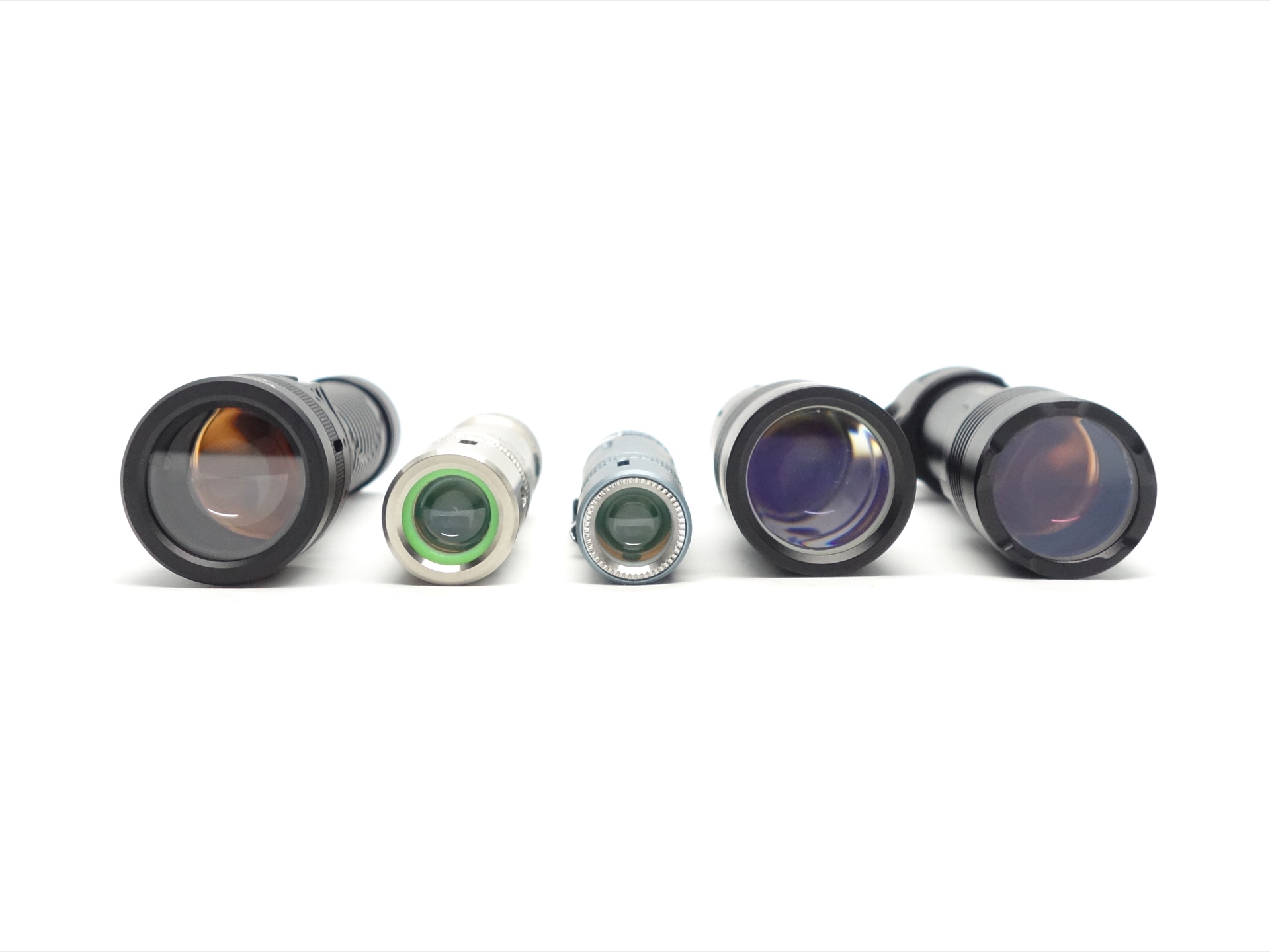
From left to right: Vastlite Versa Bow, Vastlite Bow, Vastlite Minima Bow, NLIGHTD L3, Amutorch BT35
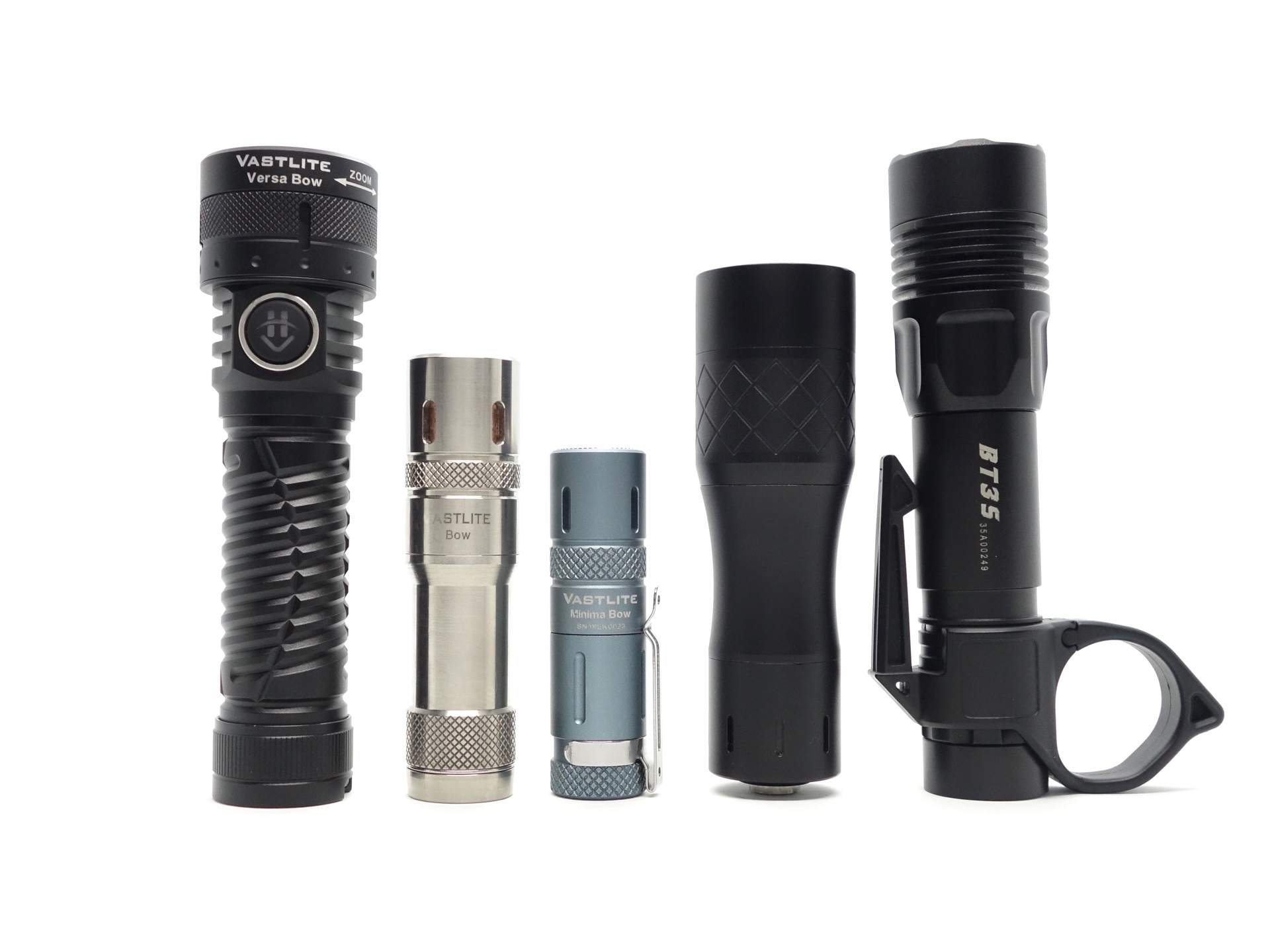
From left to right: Vastlite Versa Bow, Vastlite Bow, Vastlite Minima Bow, NLIGHTD L3, Amutorch BT35
User interface#
The NLIGHTD L3 MAO has a forward-clicky tail switch.
There are two main modes: Low and High. And one blinky mode: Strobe.
| State | Action | Result |
|---|---|---|
| Off | Half press | Momentary on (High) |
| Off | Half press within 1 second | Cycle (Low, High) |
| Off | Click | On (High) |
| Off | 2H | Strobe |
| On | Click | Off |
Mode memory#
The torch starts on High.
Low voltage protection#
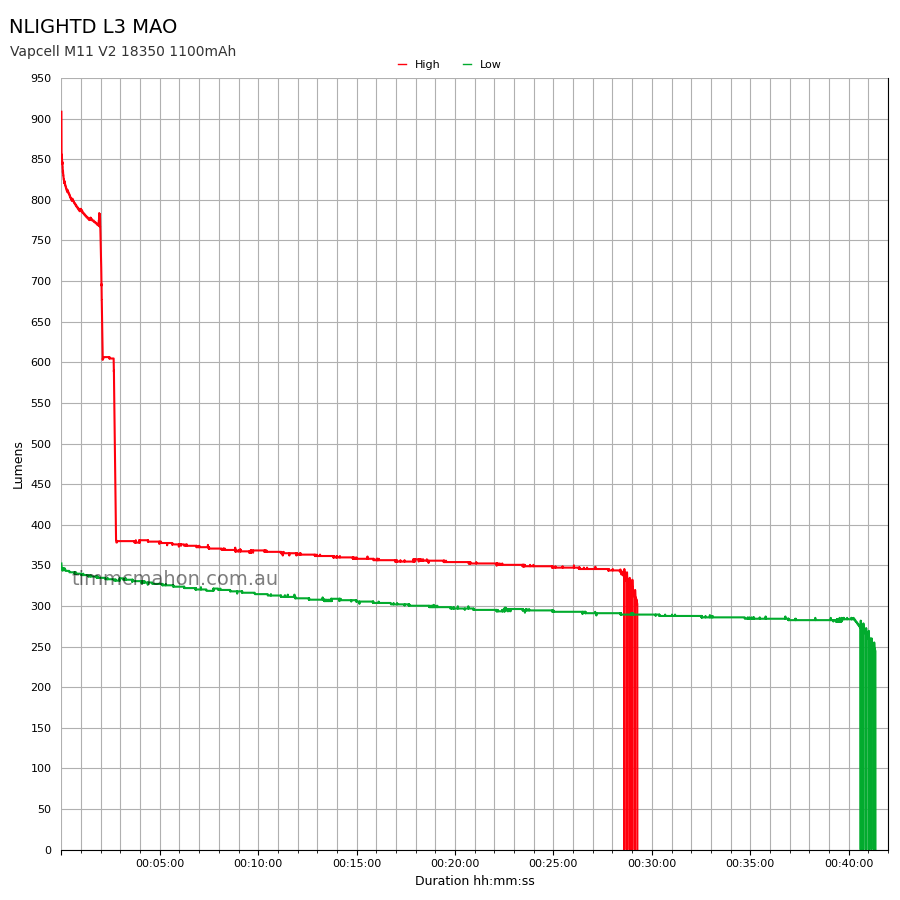
I left the NLIGHTD L3 MAO on for 9 hours while doing a runtime test on Low mode with a Vapcell M11 V2 and the voltage dropped to 2.00V. The light turned off after 29 minutes. The voltage would have been about 3.05V at 29 minutes. But the voltage continued to drop to 2.00V after 9 hours.
Pulse Width Modulation#
I did not notice any visible PWM (flickering).
What I like about the UI#
- It is simple to use.
- There is a Strobe mode.
What could be improved#
I am pretty happy with this user interface.
Batteries and charging#
Battery#
A flat top NLIGHTD 18350 3.7V Li-ion 1600mAh cell arrvied with a voltage of 3.78V.
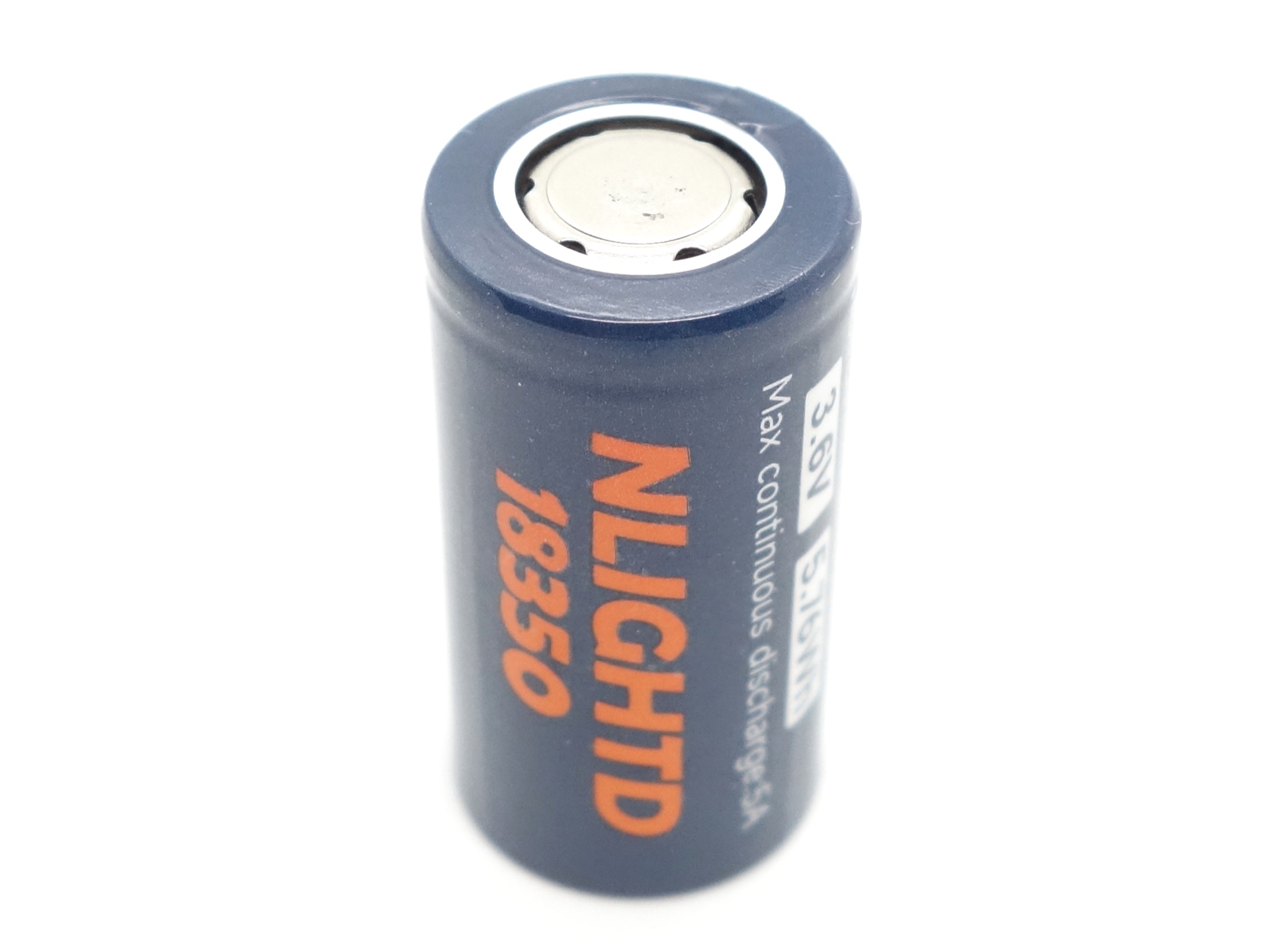
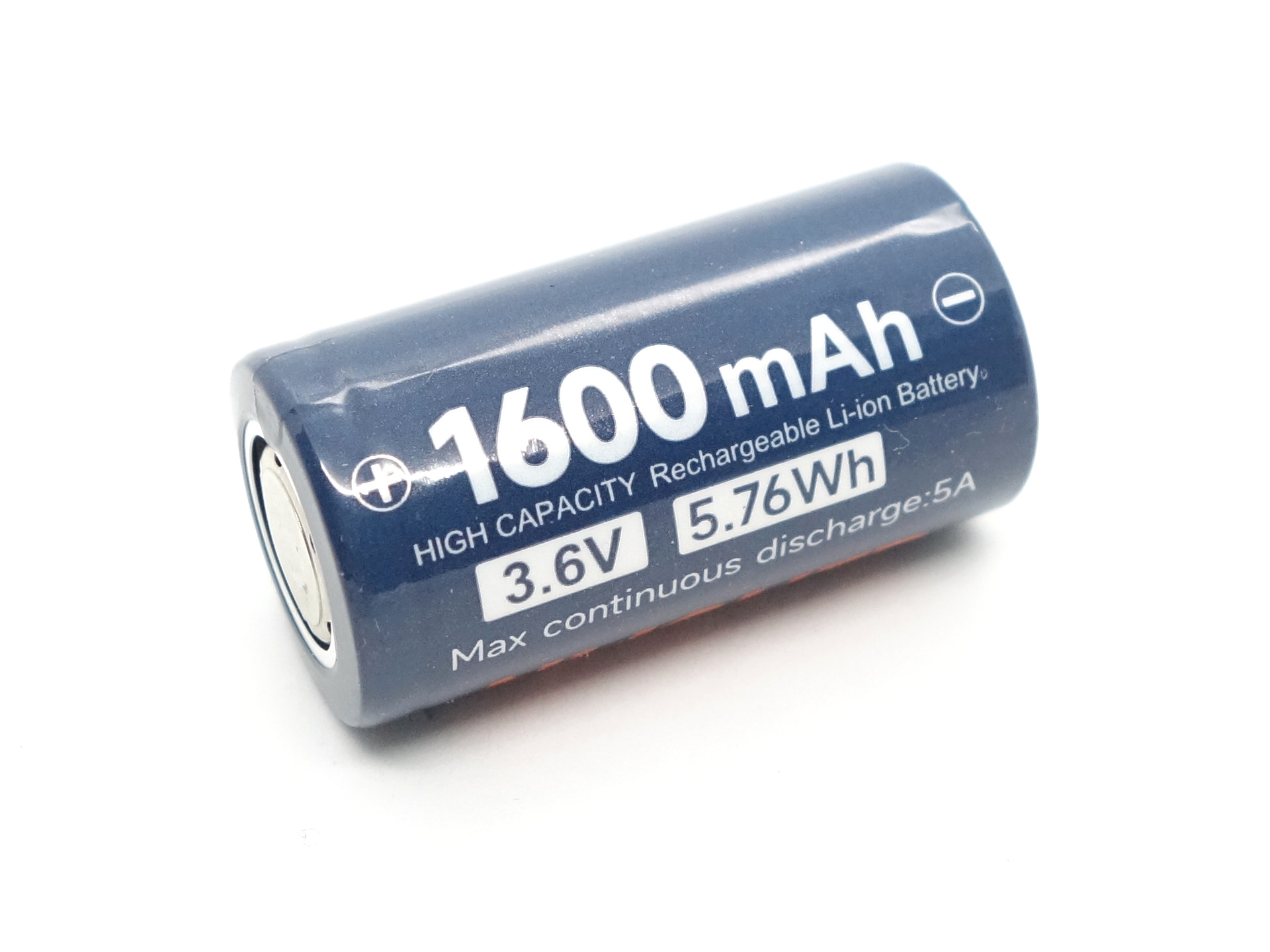
The cell was isolated with a piece of plastic to stop the torch from accidentally turning on.
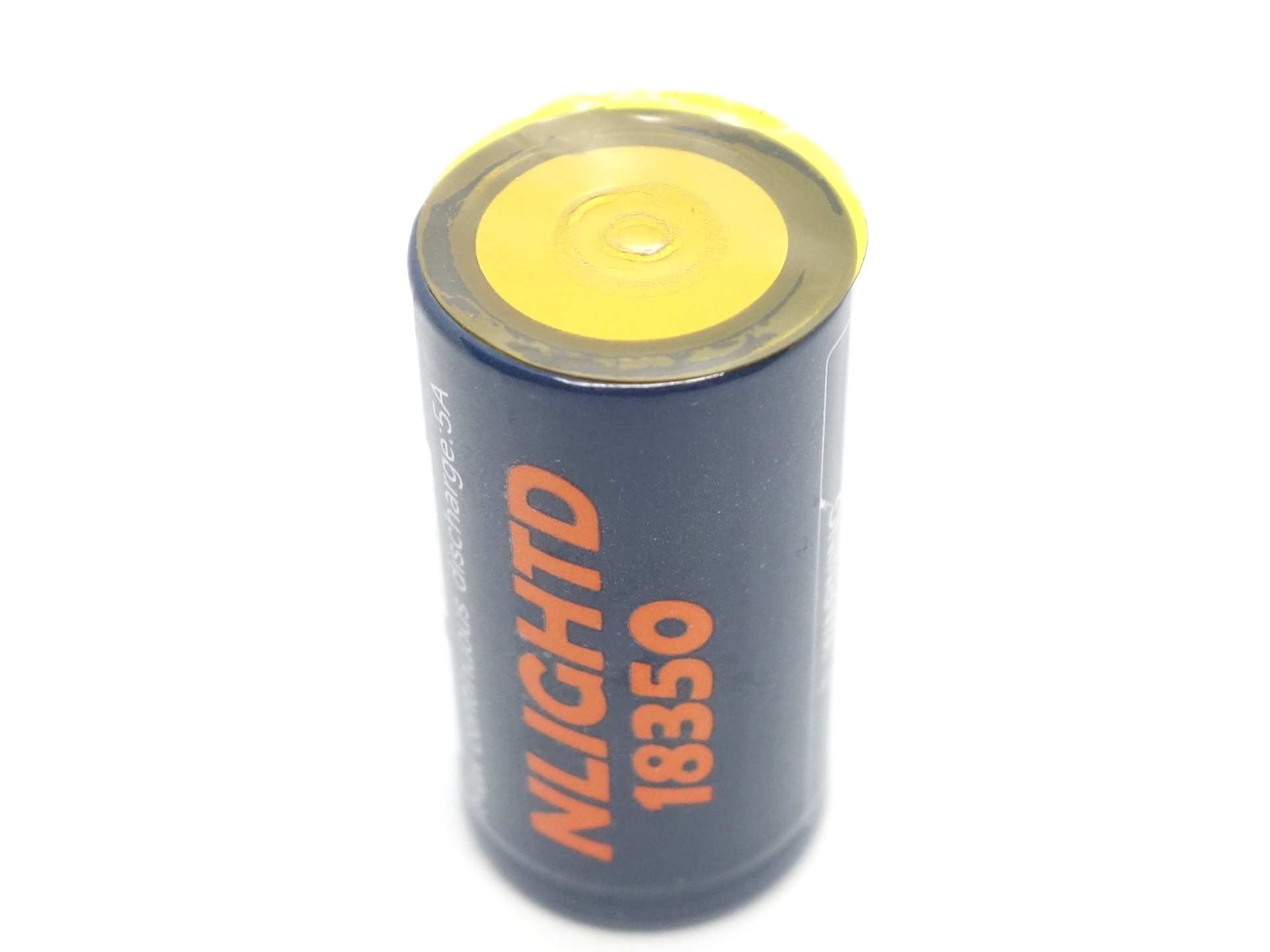
I tried the following cells:
| Cell | Top | Compatible? | Comment |
|---|---|---|---|
| Vapcell M11 V2 18350 3.7V Li-ion 1100mAh (yellow) | Flat | Yes | |
| KeepPower IMR18350 3.7V Li-ion 1200mAh | Button | Yes | |
| Manker 18350 3.7V Li-ion 1100mAh USB-C | Button | No | Too long. |
| Olight ORB-183C11 3.7V Li-ion 1100mAh | Button | No | Too long. |
| Wuben ABJ1100C 18350 3.7V Li-ion 1100mAh | Button | No | Too long. |
| Vapcell N40 18650 3.7V Li-ion 4000mAh | Flat | Yes | |
| Samsung 30Q 18650 3.7V Li-ion 3000mAh | Flat | Yes | |
| Acebeam ARC18650H-310A 3100mAh USB-C 22-J6 Black | Button | No | Too long. |
Charging#
There is no built-in charging.
Performance#
Specifications from the user manual:
| ANSI/NEMA FL1 | High | Low | Strobe |
|---|---|---|---|
| Output (lumens) | 1,000 | 360 | 430 |
| Runtime | |||
| Beam Distance (metres) | 1,500 | 900 | |
| Beam Intensity (cd) | 562,500 | 202,500 |
I tested the light using:
- Flat top NLIGHTD 18350 3.7V Li-ion 1600mAh cell.
- Flat top Vapcell M11 V2 18350 3.7V Li-ion 1100mAh (yellow) cell.
- Flat top Vapcell N40 18650 3.7V Li-ion 4000mAh cell.
Lumen measurements#
I used a UNI-T UT210E clamp meter to measure the current at turn on.
| Cell | Mode | Amps at start | Specs | Lumens @turn on | Lumens @30 sec | Lumens @10 min |
|---|---|---|---|---|---|---|
| 18650 | Low | 1.49 A | 345 | 338 | 316 | |
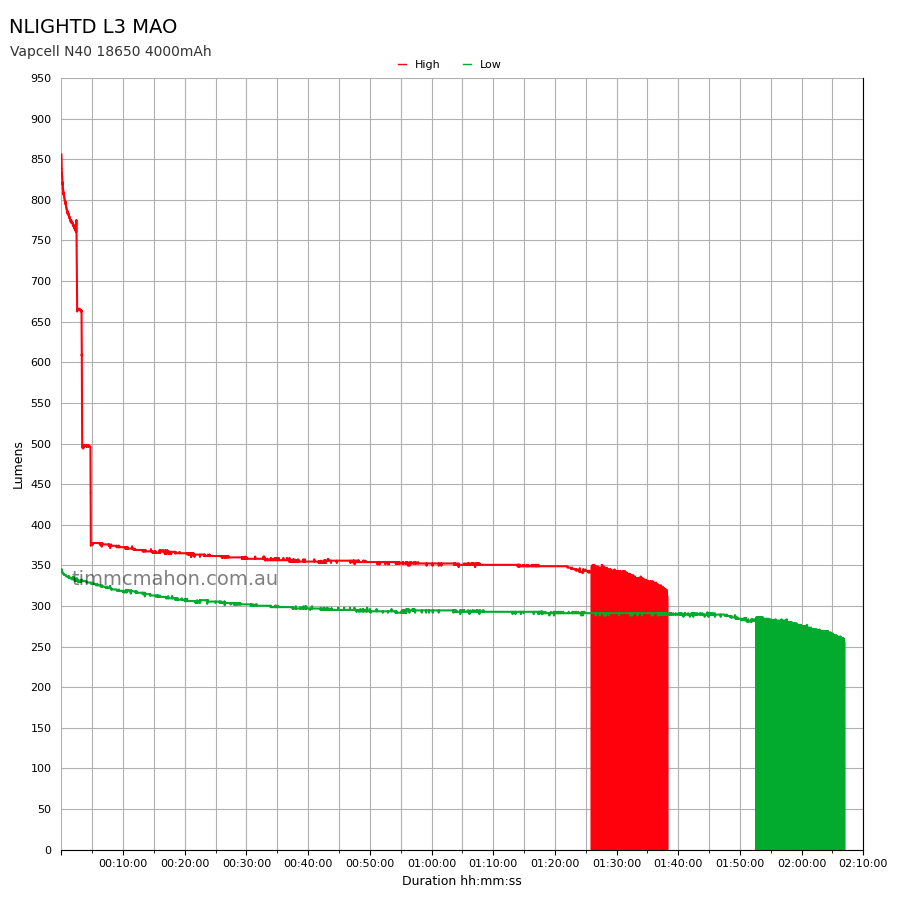
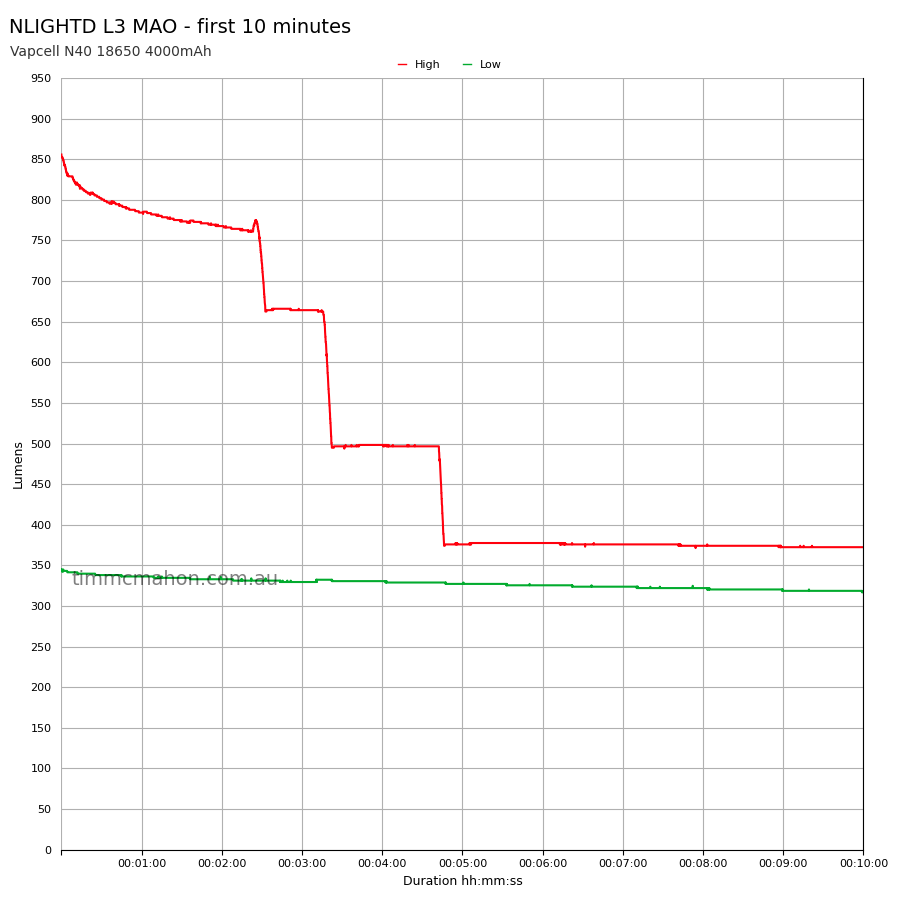
| 18650 | High | 5.38 A | 1,000 | 855 | 798 | 601 |
| 18350 | Low | 1.52 A | 350 | 339 | 316 | |
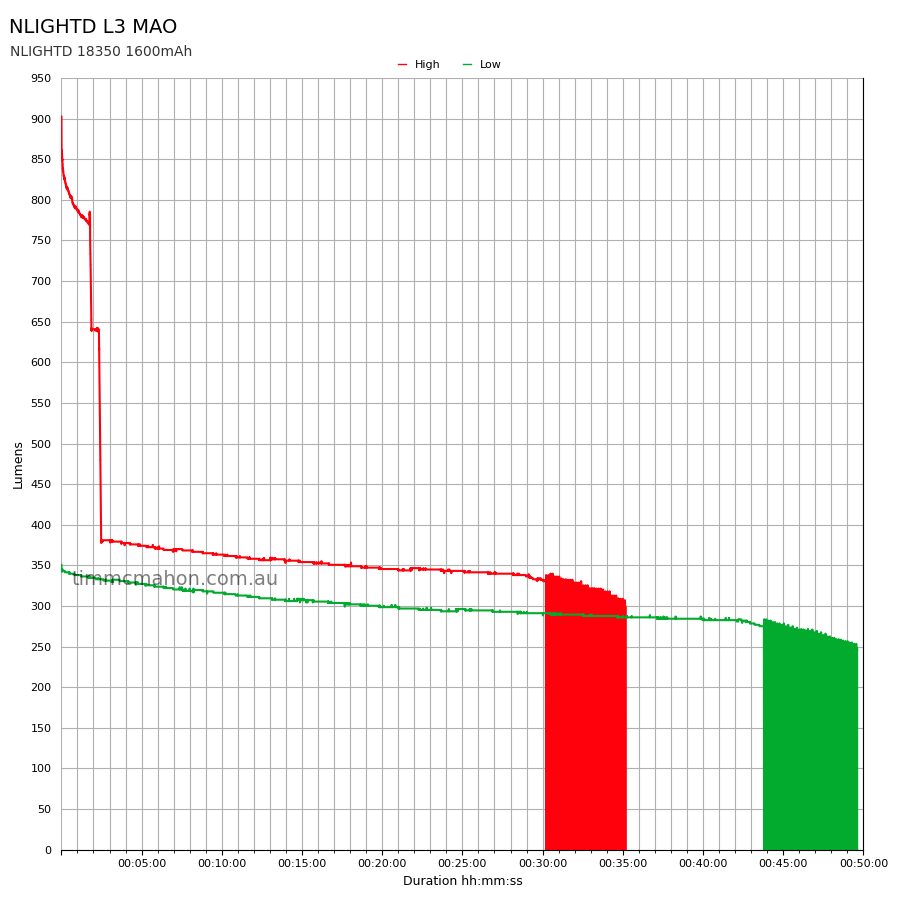
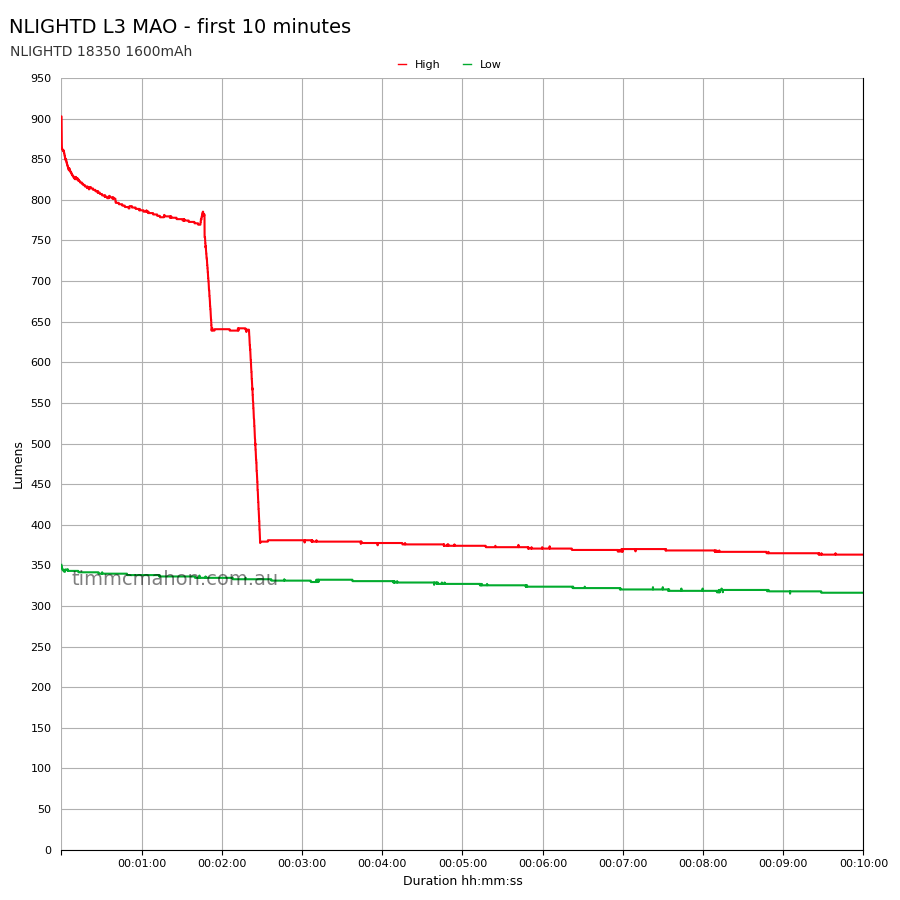
| 18350 | High | 6.00 A | 1,000 | 902 | 807 | 363 |
| M11V2 | Low | 1.52 A | 352 | 341 | 314 | |
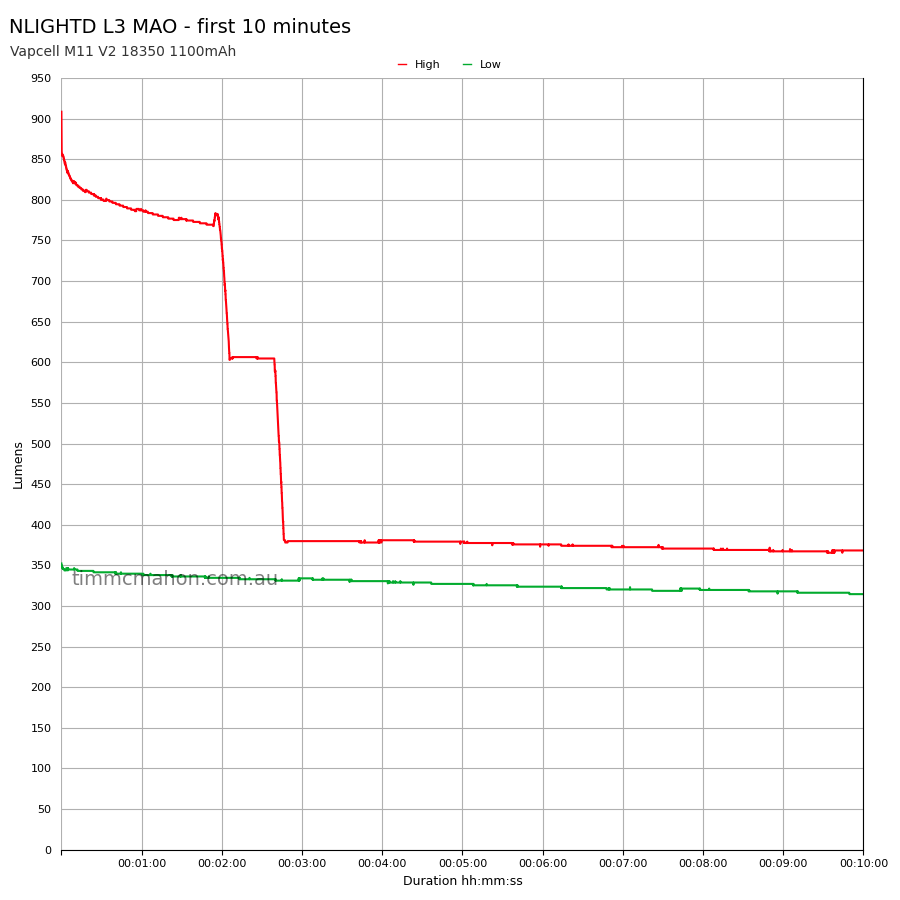
| M11V2 | High | 6.80 A | 1,000 | 908 | 800 | 368 |
This version of the NLIGHTD L3 may be pushing the LEP module a bit too hard. It reaches 6.8A on High. The prototype reached 5.7A on High.
The lumen output is lower than expected and there is a dark hole in the middle of the beam when using High mode.
Standby drain#
There is no standby drain. This torch has a forward-clicky tailswitch.
Runtime graphs#
I used my own DIY lumen tube with a TSL2591 sensor and forked bmengineer’s project RuTiTe to record runtimes.
Note: Lumen measurements may be off by 10% with my DIY lumen tube.
The room temperature was approximately 22 C.
18650#
18350#
Vapcell M11 V2 18350#
Runtime#
Here is a summary of the runtime results:
| Cell | Mode | User manual | Runtime | Turn off | Final voltage |
|---|---|---|---|---|---|
| 18650 | High | 1h 26min 9s | 1h 38min 25s | 3.08 | |
| 18650 | Low | 1h 52min 37s | 2h 6min 57s | 3.04 | |
| 18350 | High | 30min 32s | 35min 31s | 3.12 | |
| 18350 | Low | 44min 53s | 49min 36s | 3.05 | |
| M11V2 | High | 29min 15s | 29min 15s | 2.00 | |
| M11V2 | Low | 40min 36s | 41min 21s | 3.08 |
“Runtime” is the time until the output reduces to 10% of the output at 30 seconds (as per the ANSI/PLATO FL1 2019 Standard).
“Turn off” is the time until my DIY lumen tube no longer detects more than one lumen.
“+” indicates that the light remained on after recording had stopped.
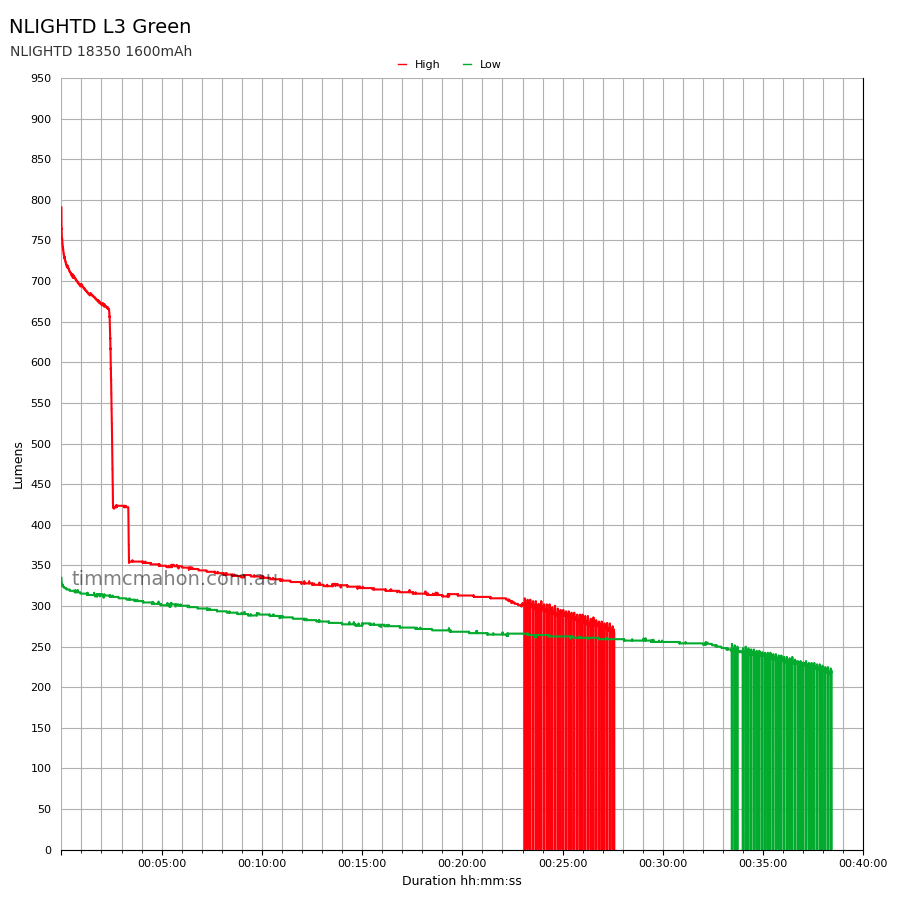
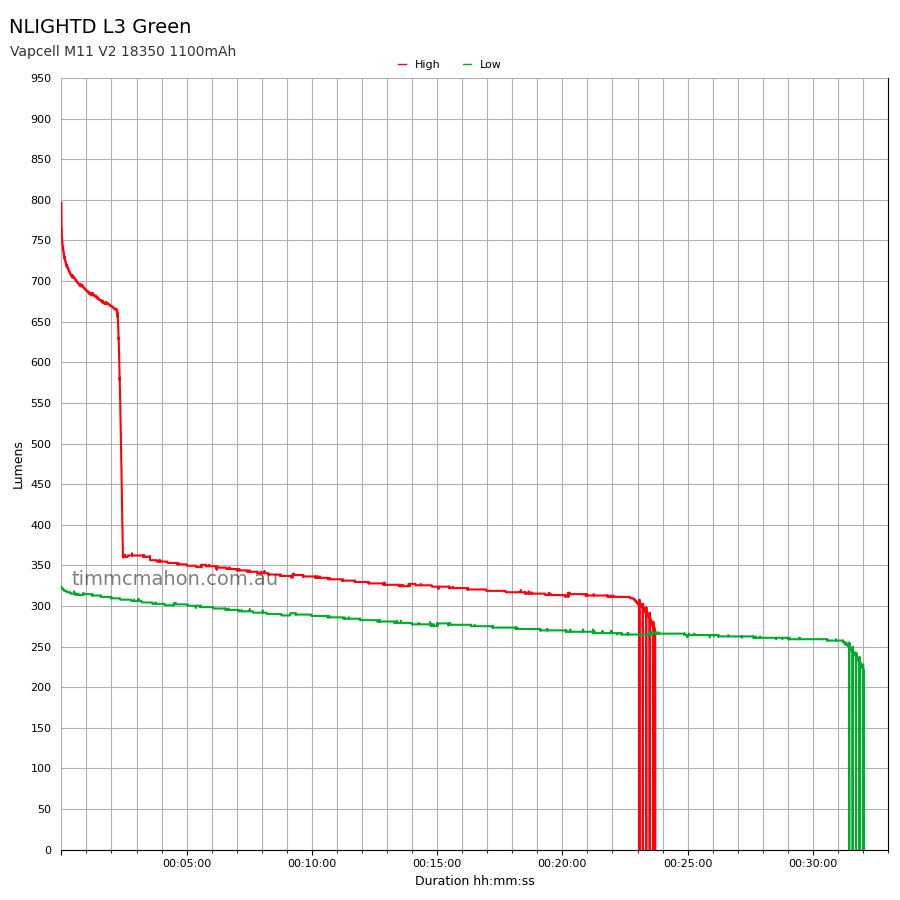
The output is well regulated but this torch gets very warm if you leave it on!
Throw#
I took lux measurements with a UNI-T UT383BT at 30 seconds. Low and High were measured at ten metres.
| Cell | Mode | Specs (cd) | Specs (m) | Candela measured (cd) | Distance (m) |
|---|---|---|---|---|---|
| 18350 | Low | 202,500 | 900 | 207,000 | 909 |
| 18350 | High | 562,500 | 1,500 | 424,800 | 1,303 |
NLIGHTD L3 Green#
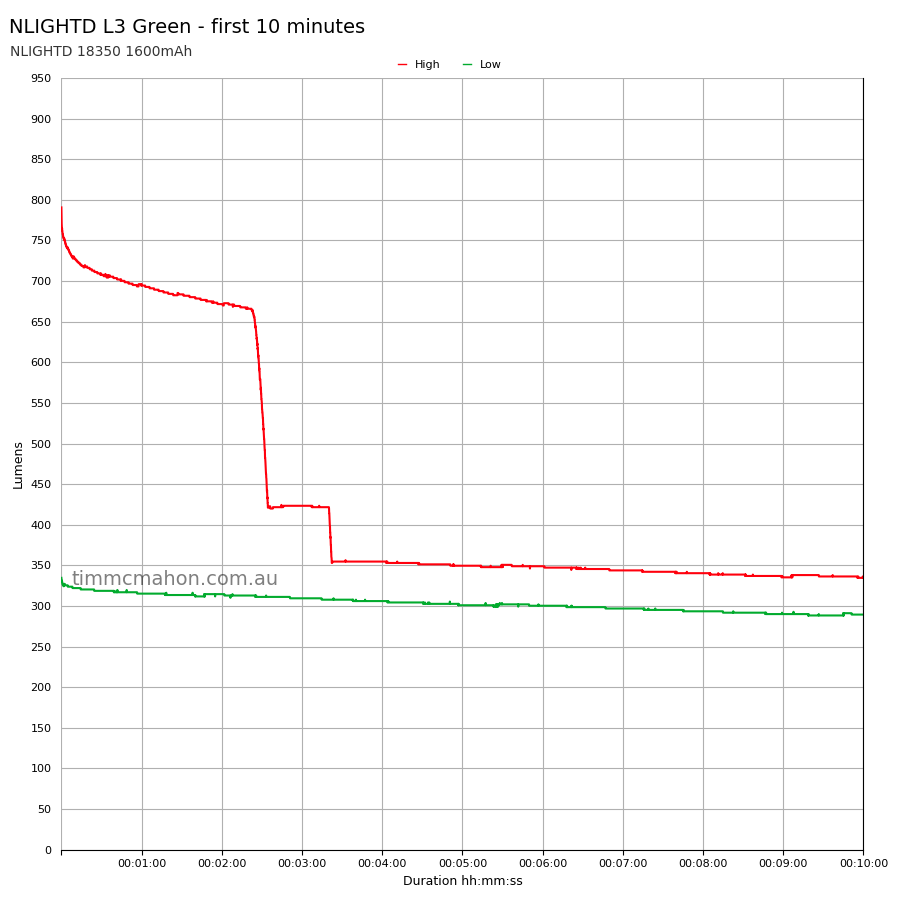
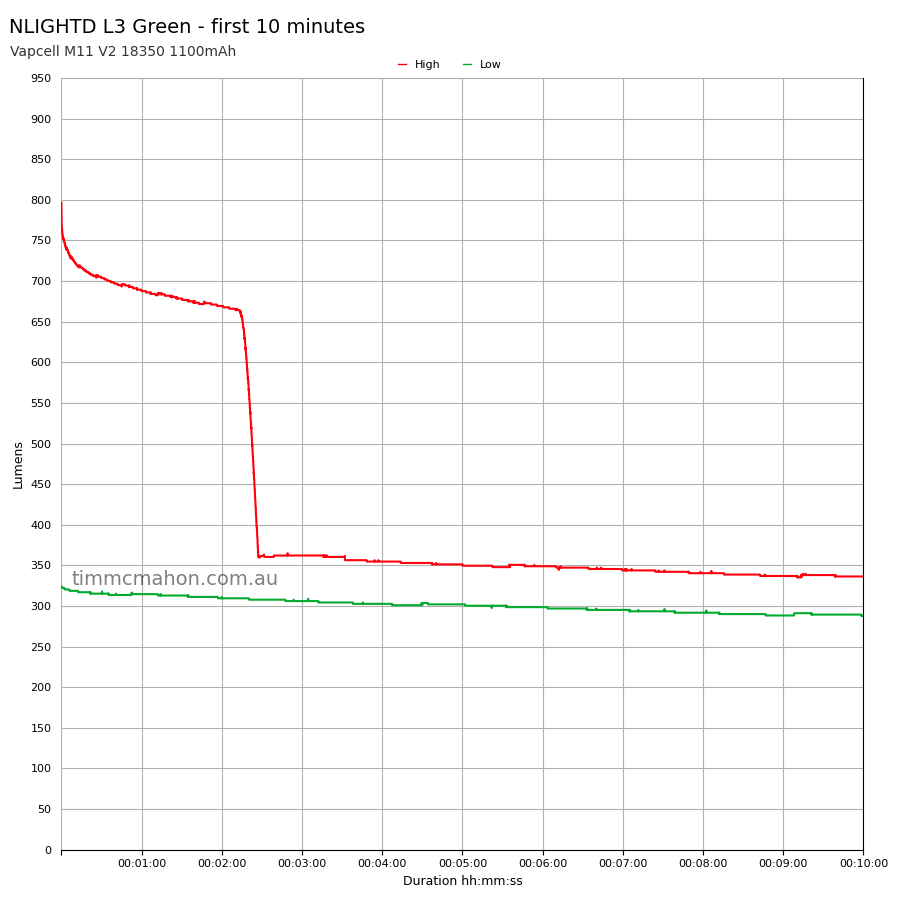
Here is the NLIGHTD L3 Green with an updated driver to reduce the current:
| Cell | Mode | Amps at start | Lumens @turn on | Lumens @30 sec | Lumens @10 min |
|---|---|---|---|---|---|
| 18350 | Low | 1.90 A | 334 | 318 | 289 |
| 18350 | High | 4.89 A | 790 | 707 | 334 |
| M11V2 | Low | 1.88 A | 323 | 315 | 287 |
| M11V2 | High | 4.88 A | 796 | 703 | 336 |
| Cell | Mode | Runtime | Turn off | Final voltage |
|---|---|---|---|---|
| 18350 | High | 23min 0s | 27min 28s | 3.09 |
| 18350 | Low | 33min 26s | 38min 25s | 3.12 |
| M11V2 | High | 23min 4s | 23min 42s | 3.12 |
| M11V2 | Low | 31min 26s | 32min 2s | 3.04 |
| Cell | Mode | Candela measured (cd) | Distance (m) |
|---|---|---|---|
| M11V2 | Low | 197,300 | 888 |
| M11V2 | High | 416,400 | 1,290 |
18350#
Vapcell M11 V2 18350#
Beamshots#
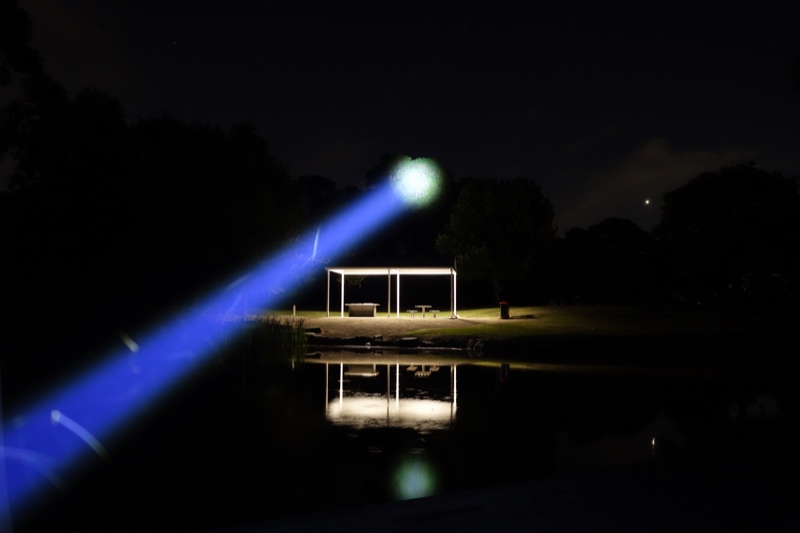
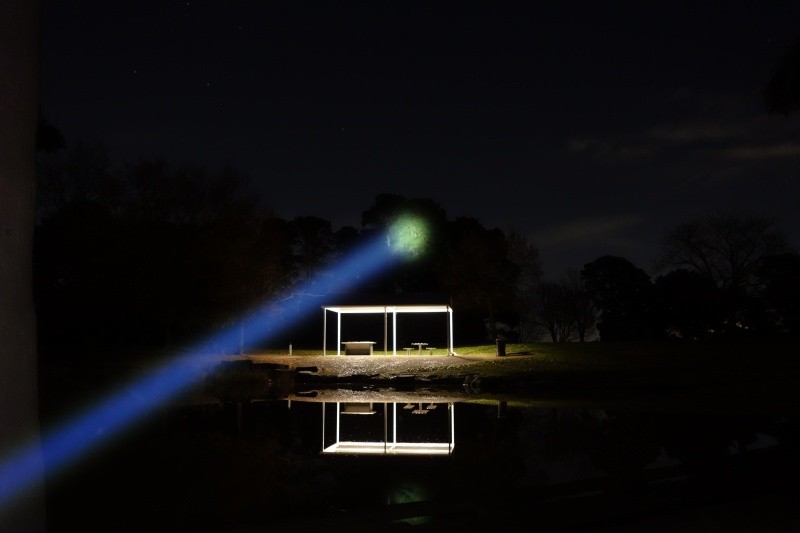
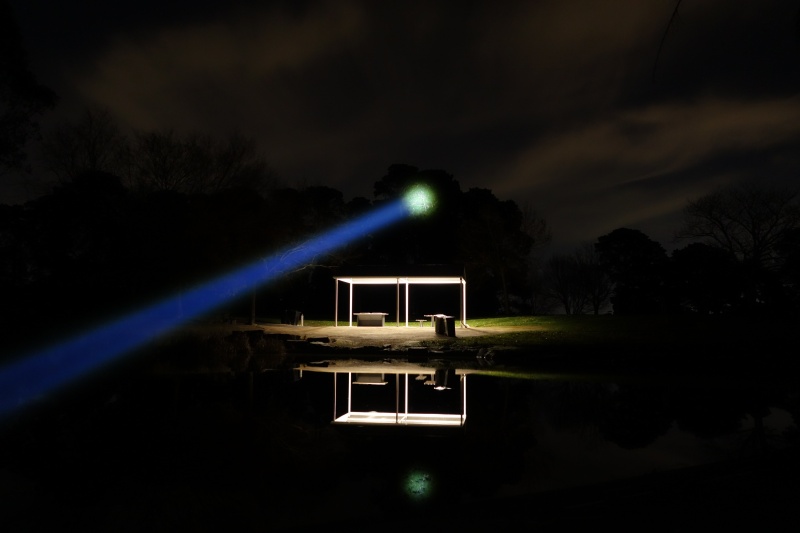
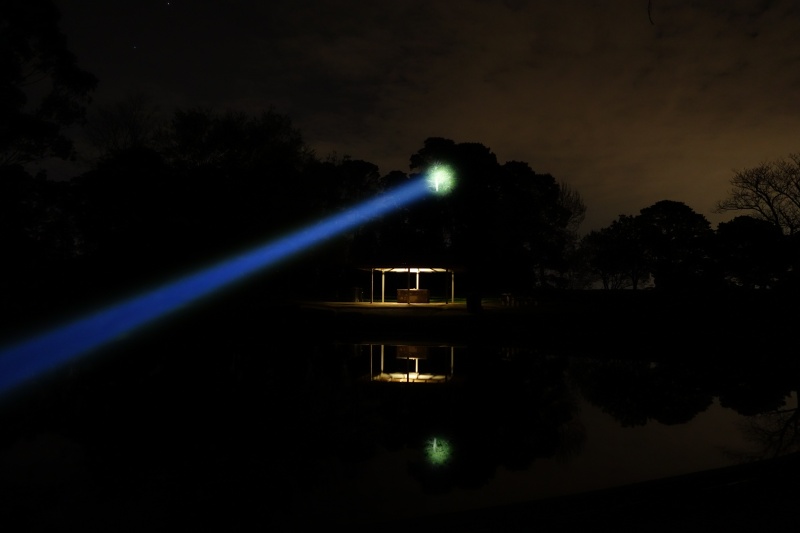
I went to a local park and I aimed the torch at a tree 100 metres away while using High.
Beamshots were taken using a Sony RX100M2 using 1.3", f3.2, ISO 800, 5000K WB.
Here is a beamshot of the NLIGHTD L3 prototype in black:
NLIGHTD L3 (High)#
NLIGHTD L2 (High)#
Lumintop Petal (LEP High)#
Here are some older photos before the BBQ and the shelter were replaced.
Amutorch BT35 (High)#
Thermal Images#
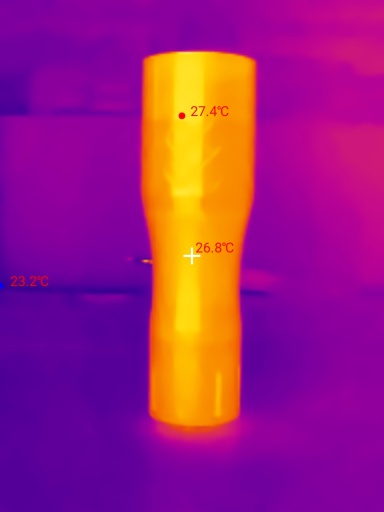
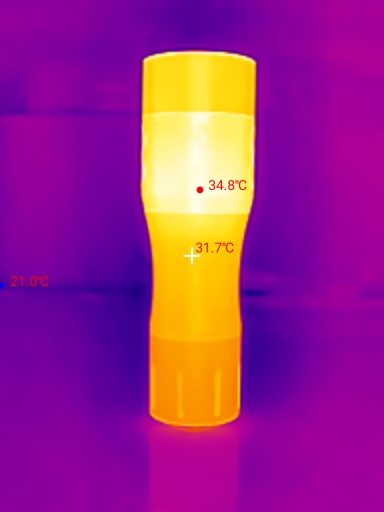
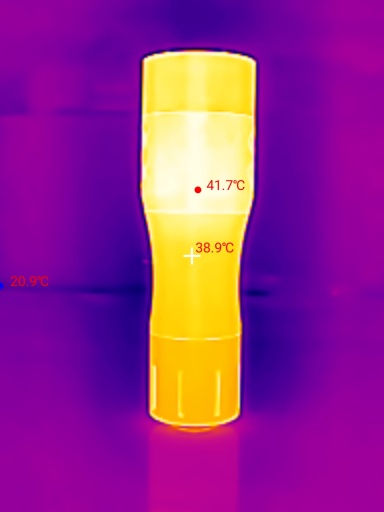
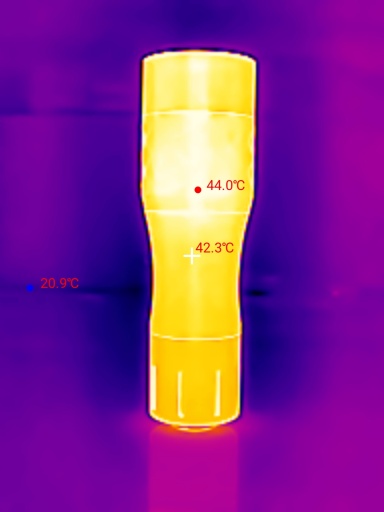
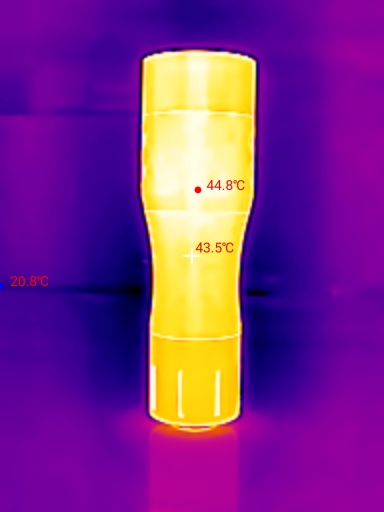
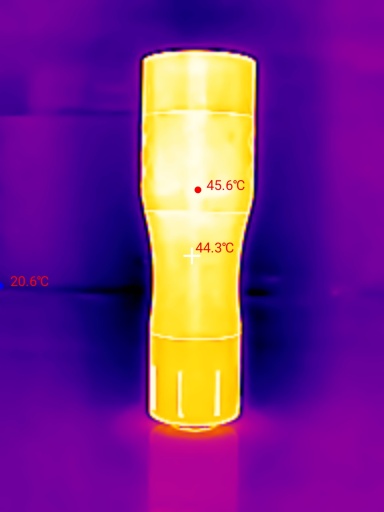
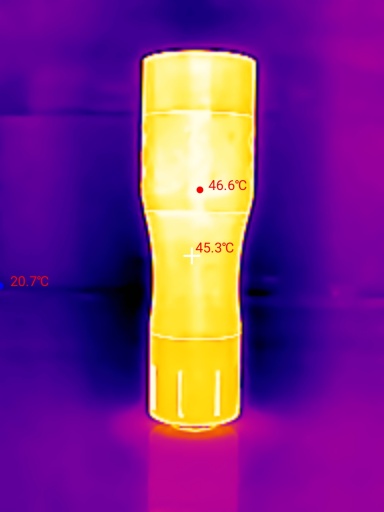
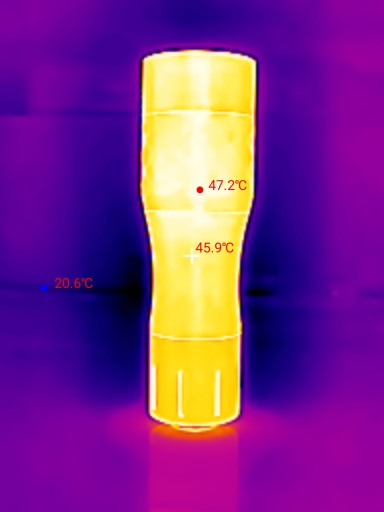
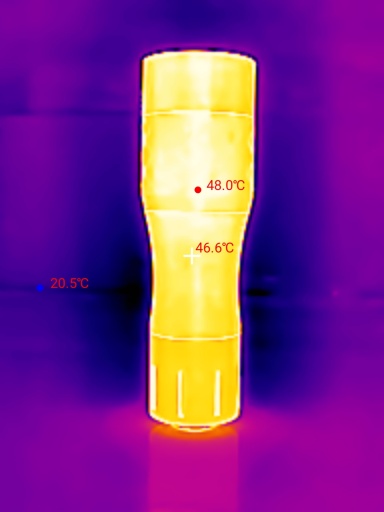
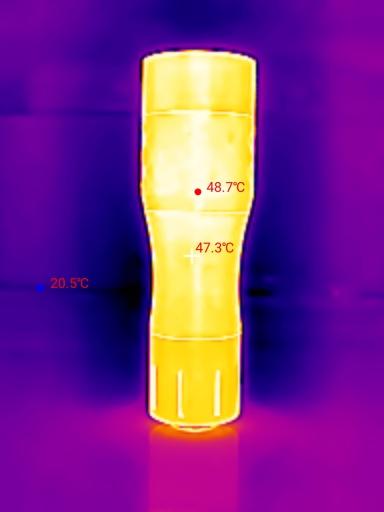
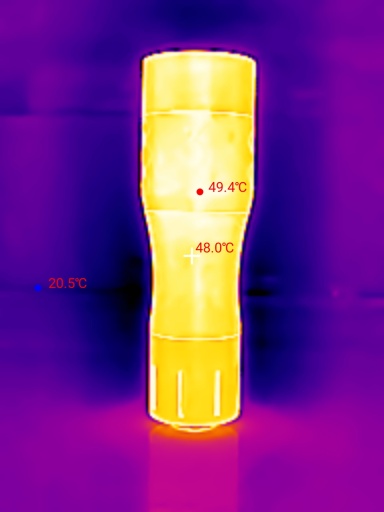
I used a Thermal Master P3 to take thermal images of the torch while using High. Get 10% off the Thermal Master P3 with code Mcmahon10
Room temperature: 20 C
| Time (mm:ss) | Max Temperature |
|---|---|
| 00:00 | 27.4 C |
| 01:00 | 34.8 C |
| 02:00 | 41.7 C |
| 03:00 | 44.0 C |
| 04:00 | 44.8 C |
| 05:00 | 45.6 C |
| 06:00 | 46.6 C |
| 07:00 | 47.2 C |
| 08:00 | 48.0 C |
| 09:00 | 48.7 C |
| 10:00 | 49.4 C |
The surface temperature reached 45 C by five minutes and 49.4 C by 10 minutes on High.
Conclusion#
The NLIGHTD L3 MAO looks and feels gorgeous but it might be pushing the shine-through LEP module too hard.
There is a “donut” shape in the beam after a few minutes when the module heats up.
The dark spot can be avoided by using a cell that does not have a high continuous discharge rate.
The lumen output and the beam distance is slightly lower compared to the NLIGHTD L3 prototype that I reviewed:
- 800 vs 974 lumens at 30 seconds
- 1,303 vs 1,609 metres at 30 seconds
Low voltage protection mostly works but it failed once during a runtime test.
Neal made another version of the L3 where the driver has a lower current. That one takes a bit longer for the dark spot to appear.
Pros:#
- Relatively small size.
- Lumen output is slightly lower than expected.
- Beam distance is slightly lower than expected.
- 18350 and 18650 tubes.
- Simple user interface.
- Output is well regulated.
Cons:#
- “donut” shape in the beam after a few minutes.
- It gets very warm after 5 minutes on High.
- Low voltage protection failed in my sample.
Price#
The NLIGHTD L3 is US$239.95 at nealsgadgets.com
It is good value for a LEP torch with a 40% discount code.
It is about US$143.97 after using the code NLDL3
Product page#
Promo code: NLDL3
Promo code: TimMcAU
Promo code: TIMMC
NLIGHTD L3 MAO at nealsgadgets.com (affiliate link)
I may earn a commission if you use an affiliate link or a promo code. This will help fund future torch reviews and tutorials.